
Afghanistan’s Quiet Crisis Is What Comes After Peace, by Christopher J.
(The author has worked on international affairs issues for much of his adult life, including engagement with Afghanistan and the broader region since shortly after 9/11. He writes about leadership, conflict, institutions, and the moral responsibilities that persist after public attention moves elsewhere.)
Not long ago in Kabul, a friend described something that would have sounded unimaginable during the height of the war.
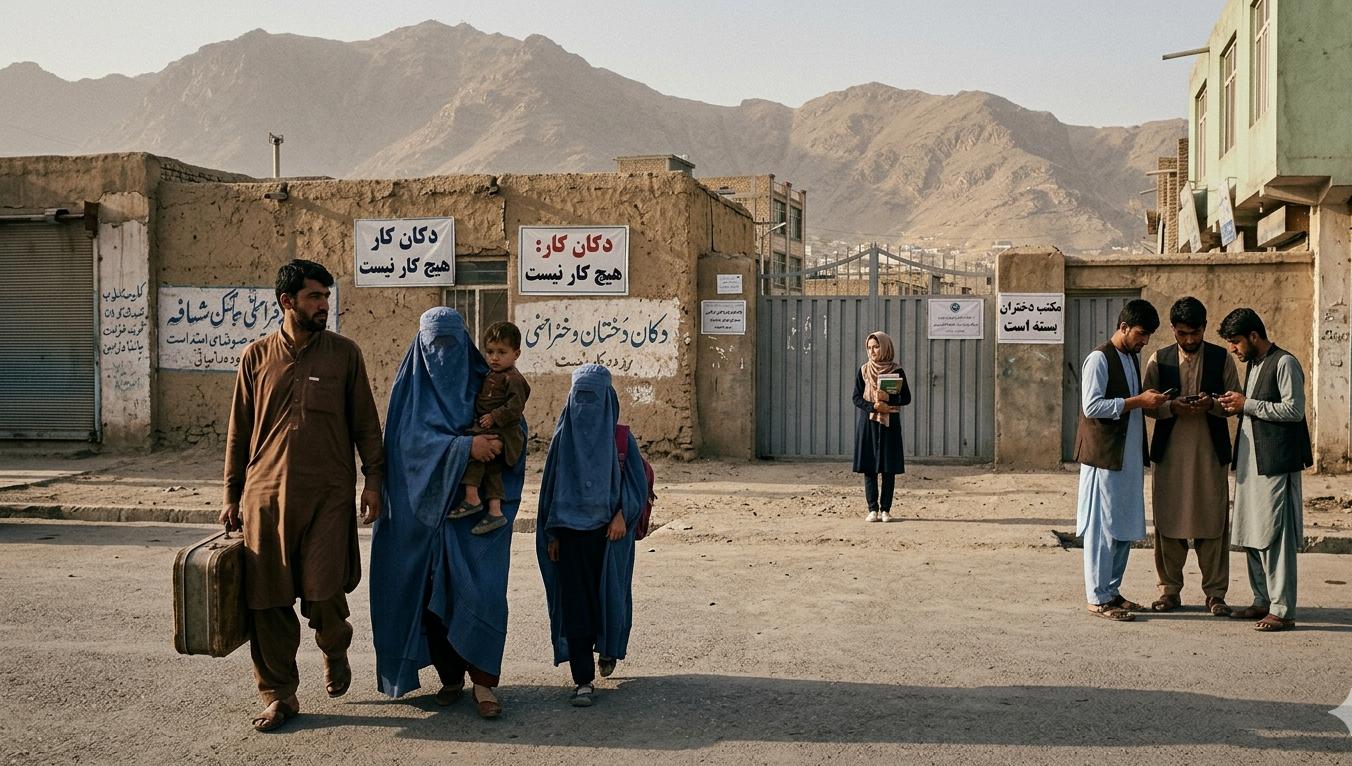
The roads were open. Traffic moved normally. Children walked to school without the familiar fear of explosions. In some neighborhoods, tea shops stayed busy late into the evening again. And yet another feeling had begun settling over parts of the city.
Young men lingering for hours over tea without work. Families quietly discussing which relative might leave the country next.
University classrooms missing many of the women who once filled them.
Professionals speaking less about rebuilding Afghanistan than about simply getting through another year. After decades of violence, even exhaustion can begin to resemble stability from a distance. I have been involved with Afghanistan in different ways since shortly after 9/11. One memory has stayed with me: a pre-dawn Mi-17 flight out of Dushanbe in October 2001, low across the ridgelines of the Hindu Kush, the metal floor vibrating through our boots. Even then, before anyone knew how long the war would last, there was a quieter understanding onboard: military campaigns eventually end. The harder question is what kind of country remains afterward. That may be the question Afghanistan is entering now. For years, Afghanistan was understood almost entirely through violence.
Districts falling.
Convoys burning.
Suicide bombings.
Drone strikes.
Night raids.
Funeral processions.
War became the language through which outsiders interpreted nearly everything they saw. Then much of the fighting stopped.
From a distance, this can resemble stabilization. But countries emerging from prolonged conflict often enter a more ambiguous phase afterward— one in which the absence of war begins concealing a different kind of pressure underneath.
The Taliban succeeded in winning the war they spent two decades fighting. The harder question is whether they can govern the peace that followed. Winning a war and governing the peace afterward are not the same task. One depends on discipline and endurance. The other depends on whether ordinary people begin to believe their lives can slowly become larger than they are today.
That transition has defeated many victorious revolutionary movements long after the battlefield outcome was settled. Afghanistan today remains suspended somewhere between exhaustion and expectation. After forty years of conflict, many Afghans still value one thing above all else: the absence of chaos. A generation raised amid bombings and displacement does not casually dismiss quiet streets. But peace changes populations over time. At first, people ask whether the shooting has stopped. Eventually, they begin asking what peace is actually delivering.
Can families survive economically?
Will daughters be educated?
Can young men build lives that do not depend entirely on migration, patronage, or armed identity?
Will rules become more predictable than the men enforcing them?
Does tomorrow feel larger than today?
Those questions are becoming harder for Afghanistan’s rulers to answer convincingly.
The Taliban inherited not simply a country damaged by war, but a society shaped by dependency, outward migration, corruption, fractured institutions, and deep fatigue. Since returning to power in 2021, they have achieved a degree of territorial control unmatched by most
Afghan governments of the past half century. But control and legitimacy are not the same thing. The economy has stabilized in narrow technical ways compared to the collapse that followed the withdrawal of international support. Yet stabilization alone does not create momentum. Large portions of the population remain caught between unemployment, aid dependency, shrinking opportunity, and rising social restriction. People can endure hardship for remarkably long periods. What becomes harder is the sense that next year will look exactly like this one.
Some of the country’s deepest losses are not measured in damaged buildings or casualty figures.
Teachers leave quietly.
Professionals depart when they can.
Women disappear from much of public life.
Young people begin planning their futures around limits rather than possibilities.
Societies can absorb this for a time. Many authoritarian states do. The danger begins when populations stop believing peace will lead anywhere beyond survival. Afghanistan’s recent history has exhausted much of the public appetite for another nationwide conflict. Many Afghans are profoundly tired of war, including people deeply unhappy with the Taliban. That exhaustion matters.
Yet resignation has consequences of its own.
In conversations with Afghans over the past several years, the question heard most often has not been whether the fighting will return, but whether there is any reason for their children to stay. A society does not need to become openly rebellious to become unstable. It only needs growing numbers of people who stop believing ordinary life offers a meaningful future. This is where security concerns quietly begin returning. Outside observers often treat extremism as a problem of ideology alone. In practice, armed networks grow where ordinary life no longer offers a credible path forward. Groups such as the Tehrik-i-Taliban Pakistan benefit from exactly these conditions.
Not because most Afghans support transnational militancy. Many do not. But prolonged stagnation lowers resistance to networks that offer identity, income, protection, or purpose where formal institutions provide little of any of them. The Taliban understand some of this themselves. Their leadership now faces a contradiction familiar to many revolutionary governments after victory. To preserve ideological cohesion internally, they cannot appear subordinate to Western security expectations. Yet to avoid deeper economic isolation, they also cannot allow Afghanistan to openly reemerge as a sanctuary for transnational militancy.
So enforcement becomes uneven. Some local actors are pressured. Others are accommodated quietly. Neighboring governments suspect more is tolerated than publicly acknowledged, whether the Taliban fully control it or not.
The harder part is that Afghanistan may do neither of the things analysts usually look for. It may not collapse. It may not stabilize.
Something narrower may emerge instead: a society where peace, poverty, repression, outward migration, and militant opportunity sit beside one another for long periods at a time. Afghanistan’s neighbors are watching closely, though not primarily for signs of collapse. Pakistan worries about cross-border militancy. China focuses on security around Xinjiang and its regional investments. Iran balances refugee pressures against concerns over extremist networks. Further north, Russia and the Central Asian states view the same landscape with familiar caution. The concern is less about sudden crisis than slow deterioration.
A generation grows up with fewer skills.
Fewer women participate in public life.
Fewer professionals remain.
More economic activity shifts informal.
More authority becomes localized.
More young men drift toward religious or armed structures because no credible alternative feels available.
This may not look like a return to the Afghanistan of the late 1990s.
What emerges could be quieter, more durable, and ultimately harder to reverse:
a country where war has largely ended, but where too many people gradually stop believing peace will ever lead anywhere beyond survival itself.