
About Author
“The author has worked on international affairs issues for much of his adult life, including engagement with Afghanistan and the broader region since shortly after 9/11. He writes about leadership, conflict, institutions, and the moral responsibilities that persist after public attention moves elsewhere.”
What the Iran Conflict Revealed About the Region.
The shift became noticeable not during a crisis meeting, but in the conversations that followed.
A few years ago, it was still possible to spend an entire meeting discussing Afghanistan and leave having discussed only Afghanistan.
Border security.
Governance.
Insurgency.
Development assistance.
The subjects were not simple, but they generally stayed in their lanes. A meeting about Pakistan was usually a meeting about Pakistan. Iran occupied its own file. India often occupied another. The issues touched one another, of course. They always had.
But they were still treated as separate problems requiring separate solutions.
I remember regional meetings years ago where entire afternoons were spent discussing border crossings, local security conditions, and development priorities. The conversation rarely strayed very far from the issue that had brought everyone into the room. Lately, that has become harder. Conversations that begin with Afghanistan increasingly end somewhere else. Questions about trade lead to discussions of security. Energy concerns become diplomatic concerns. Infrastructure projects are viewed through strategic lenses. Topics that once belonged in separate meetings now tend to arrive in the same room.
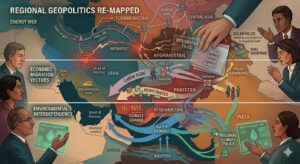
In one recent discussion, a briefing on border management produced questions about regional investment risk before the first hour had ended. The shift barely registered at the time. Similar moments have become increasingly common. The briefing papers still arrived organized by subject. The conversation did not. The recent conflict involving Iran highlighted something larger than the crisis itself. It exposed how quickly a security shock in one part of the region now travels through economies, institutions, and political calculations elsewhere. For many officials across the region, some of the first signs appeared not in intelligence reporting but in economic indicators.
In Pakistan, concerns about disruptions in the Strait of Hormuz quickly translated into concerns about fuel prices. Transportation costs rose. Grocery prices followed. Discussions that began with regional security soon became discussions about household
budgets and economic uncertainty. A conflict centered in the Gulf was being felt in local markets hundreds of miles away. The concern was not simply the availability of fuel. It was how quickly events elsewhere could shape decisions at home. Afghanistan offers a useful example. Not long ago, discussions about the country often centered on insurgency, governance, political stability, and counterterrorism. Those concerns remain.
What feels different is how quickly other subjects enter the conversation. In one recent meeting, participants arrived expecting to discuss border management and cross-border movement. Within twenty minutes the discussion had shifted toward economic
questions. By the end, the conversation centered on investment, regional stability, and long-term risk. Iran had not appeared on the agenda. At some point, it becomes difficult to discuss Afghanistan’s future without also discussing the stability of its neighbors, the health of regional trade, or the willingness of outside investors to accept long-term risk. The country has not changed location.
The environment around it has become harder to separate. The same pattern is increasingly visible inside the institutions responsible for managing the region.
Economic ministries find themselves discussing security concerns. Security officials spend more time evaluating economic and political risk. A discussion about infrastructure quickly becomes a discussion about financing. Financing leads to questions of political influence. Political influence raises concerns about security and access. In more than one meeting, participants have found themselves searching for the right ministry or agency to take the lead because the issue no longer fits neatly inside a single portfolio. The systems have become more interconnected than many institutions were designed to manage. None of this means the region is becoming more unified. Historical disputes, competing interests, and political rivalries remain firmly in place. Yet beneath those differences, a quieter reality is emerging.
Over the past year, it has become increasingly common to watch a meeting drift far beyond the issue that originally brought everyone into the room. More than once, participants have stopped midway through a discussion and remarked that they were no longer talking about the issue listed on the agenda. That observation may say more than any briefing paper. For many years, Afghanistan, Pakistan, Iran, and India could be discussed as separate strategic problems. The differences remain real. But events increasingly refuse to stay confined to the country where they begin. A disruption in the Gulf affects fuel costs elsewhere. Economic pressure alters political calculations. Security concerns influence investment decisions. Issues that once moved through separate channels now travel together. The recent Iran conflict did not create that reality. It revealed how far the region had already moved in that direction. The maps still look the same. The operating environment does not.