
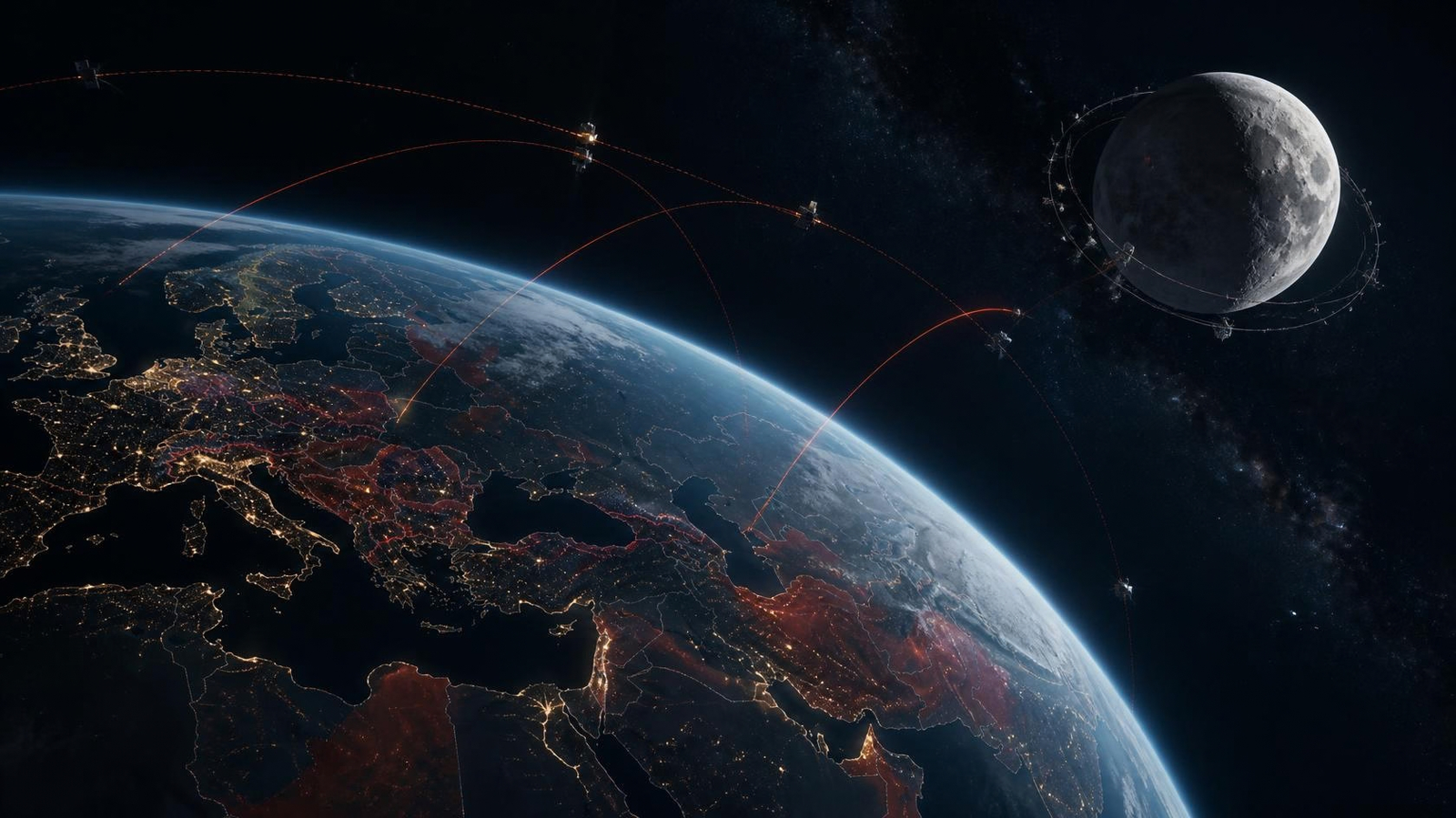
From Earth’s Borders to Lunar Orbit: The New Geography of War
The world is entering an era in which war can no longer be understood simply as a confrontation between two armies, fought across a defined border and measured by territory gained or lost. Across different regions, armed conflicts, political violence and strategic rivalries are unfolding simultaneously. The battlefield is becoming more dispersed, more technological and increasingly difficult to confine to geography.
What has changed most profoundly is not merely the number of conflicts. It is the geography of war itself.
For much of modern history, the battlefield was a physical place. Armies crossed borders. Cities were surrounded. Naval fleets fought at sea. Aircraft contested the skies. The consequences of war, although devastating, could generally be traced back to a particular territory.
That geography is now being transformed.
A war can begin in one region and disrupt the lives of people thousands of miles away. A maritime chokepoint can become an economic weapon. A cyber operation can cross national borders without a soldier crossing a frontier. A drone can threaten an expensive military platform at a fraction of its cost. A satellite can become as strategically important as a military installation. And increasingly, strategic thinkers are examining whether the space between Earth and the Moon could eventually become another arena of geopolitical competition.
The conflict involving Iran and the United States offers a striking illustration of this transformation. Its military and political origins may lie in the Middle East, but its consequences have not remained there. The disruption of shipping through the Strait of Hormuz demonstrated how a geographically narrow waterway can become a vulnerability for an interconnected global economy.
The Strait is only about 21 nautical miles wide at its narrowest point, yet its strategic importance is enormous. The International Energy Agency estimates that around 20 million barrels of crude oil and petroleum products moved through the Strait each day in 2025—roughly a quarter of global seaborne oil trade. Around 80 percent of the oil passing through it was destined for Asian markets. The Strait is also critical to liquefied natural gas, with Qatar and the United Arab Emirates together accounting for a significant share of global LNG trade through the route.
This is why Hormuz is far more than a regional security issue.
When the waterway is disrupted, the consequences travel through the architecture of globalization itself. Tankers are delayed or rerouted. Shipping becomes more expensive. Insurance premiums rise. Energy markets react. Governments reconsider strategic reserves and alternative routes. Businesses begin calculating higher transportation and production costs. Eventually, the effects can reach ordinary consumers far from the battlefield.
The lesson is fundamental:
A war may involve two countries, but its consequences can belong to the world.
A missile may be fired in one region while energy prices change in another. A shipping route may be threatened in one sea while manufacturers thousands of miles away begin worrying about supply and transportation costs. A regional conflict can become an energy crisis, and an energy crisis can become a global economic problem.
The battlefield, in other words, is no longer confined to the battlefield.
This is one of the defining characteristics of modern warfare. National security is no longer exclusively about protecting territory, military bases and borders. It increasingly involves protecting the systems that allow modern societies to function: ports, pipelines, electricity grids, telecommunications, data networks, undersea cables, satellites, financial systems and supply chains.
The more interconnected the world becomes, the more points of vulnerability it creates.
Technology has accelerated this transformation. Drones have changed the economics of warfare by allowing relatively inexpensive unmanned systems to perform surveillance and strike missions once associated with much more expensive platforms. Electronic warfare can interfere with communications and navigation. Cyber operations can target critical infrastructure without a conventional invasion. Satellite systems provide intelligence, positioning and communications that have become increasingly important to contemporary military operations.
The result is a battlefield that increasingly exists in several domains simultaneously.
There is the physical battlefield.
There is the maritime battlefield.
There is cyberspace.
There is the electromagnetic spectrum.
There is the information environment.
And above them all is space.
This does not mean conventional warfare has disappeared. Tanks, artillery, infantry, aircraft and naval forces remain central to military power. What has changed is the technological ecosystem surrounding them.
The battlefield has become networked.
A soldier on the ground may depend on information gathered by a satellite. A drone may depend on communications infrastructure. A missile may rely on navigation data. A naval vessel may depend on satellite communications and digital systems. A government may depend on civilian infrastructure deeply integrated into global networks.
Disrupt one component, and the consequences can spread through the system.
This makes modern warfare simultaneously more precise and more unpredictable.
Precision technology promises the ability to strike specific targets with greater accuracy. Yet the interconnected nature of modern infrastructure means that an attack on one node can create consequences far beyond the original target.
That paradox is becoming increasingly difficult to ignore.
And then there is space.
It would be misleading to claim that the next war will definitely be fought on the Moon. There is no evidence that such a war is inevitable. But it is equally difficult to ignore the fact that military planners and strategic thinkers are beginning to examine the space between Earth and the Moon—known as cislunar space—as a potential future domain of competition.
The reason is straightforward. The Moon is no longer viewed exclusively through the lens of science and exploration. As lunar missions expand and governments and private companies consider communications, navigation, scientific infrastructure and potential resource-related activities, the strategic importance of the lunar environment may also grow.
A 2026 analysis by Georgetown’s Security Studies Review described cislunar space as a potential region of strategic competition as major space powers expand their ambitions beyond Earth’s immediate orbit.
The idea may sound futuristic, but strategic competition has historically followed technological and economic significance.
The oceans became strategic because global trade depended upon them.
Airspace became strategic because aviation transformed warfare and commerce.
Earth’s orbit became strategically important because satellites became essential to communications, navigation, intelligence and surveillance.
If lunar infrastructure becomes sufficiently important in the future, the space surrounding the Moon could acquire strategic significance of its own.
The irony is difficult to miss.
Humanity is preparing to extend its technological reach farther into space while still struggling to prevent wars on Earth.
We are developing artificial intelligence capable of processing vast quantities of information. We are building increasingly autonomous systems. We are connecting societies through digital networks. We are returning to the Moon with ambitions that go beyond the brief lunar missions of the twentieth century.
Yet on Earth, civilians continue to experience the oldest consequences of war: displacement, hunger, fear, separation and death.
This is perhaps the deepest contradiction of our technological age.
The methods of war are becoming more sophisticated, but the human tragedy of war remains brutally familiar.
A missile may be more accurate than those used by previous generations, but the person beneath it remains human. A drone may be remotely operated from hundreds or thousands of kilometres away, but the home it destroys is still someone’s home. A cyberattack may appear on a computer screen as a technical incident, yet its consequences can reach hospitals, electricity networks, communications systems and ordinary families.
The distance between the attacker and the victim may be increasing.
The distance between conflict and consequence is shrinking.
That may be one of the defining characteristics of twenty-first-century warfare.
The world is interconnected enough that no major conflict exists entirely in isolation. Energy markets connect producers and consumers across continents. Shipping networks connect ports across oceans. Digital systems connect economies almost instantaneously. Financial markets can react to geopolitical shocks before ordinary citizens fully understand what has happened.
This interconnectedness has produced extraordinary economic benefits.
It has also created extraordinary vulnerabilities.
Hormuz is therefore more than a story about a narrow waterway in the Middle East. It is a reminder that globalization has created strategic chokepoints whose disruption can affect people who have never seen the battlefield and may have no connection whatsoever to the conflict.
A war can remain geographically local while becoming economically global.
That is the new geography of war.
And the geography is likely to become even more complicated.
The future battlefield may not have a single front line. It may consist of overlapping systems: a naval blockade here, a cyber operation there, drone strikes somewhere else, satellite interference above the atmosphere and economic disruption thousands of kilometres away.
The battlefield may be everywhere precisely because modern societies are connected everywhere.
Yet while the machinery of war is changing, the moral question remains remarkably old.
What is the purpose of all this power if the human being remains its ultimate casualty?
This question becomes particularly uncomfortable when viewed against the scale of technological ambition.
Humanity wants to establish a deeper presence beyond Earth. It wants artificial intelligence to solve increasingly complex problems. It wants autonomous machines to operate in environments too dangerous for humans. It wants faster communications, more powerful satellites and greater access to space.
These are extraordinary achievements.
But technological capability and moral progress are not the same thing.
A civilization can become extraordinarily advanced at reaching distant places while remaining tragically incapable of protecting people where it already lives.
Perhaps that is the central paradox of our time.
Everything about war is changing—its weapons, its speed, its domains, its economics and its reach. Yet humanity is still dying in ways that are painfully familiar.
The question, therefore, should not simply be where the next war will be fought.
It should be what we are becoming as we acquire the ability to fight in more places, through more systems and at greater distances.
Will the next strategic frontier be another sea lane? Another digital network? Another satellite orbit? The space between Earth and the Moon?
Perhaps.
But the more important frontier may be an entirely different one: the boundary between what humanity is capable of doing and what humanity is willing to do.
The history of warfare has always been a history of technological adaptation. Spears became swords. Swords gave way to firearms. Firearms evolved into artillery, aircraft, missiles and nuclear weapons. Now artificial intelligence, autonomous systems, cyber capabilities and space technologies are reshaping the strategic environment once again.
But there is no technological upgrade for grief.
No artificial intelligence can make the loss of a child less painful.
No satellite can rebuild a destroyed home.
No precision weapon can make a dead civilian alive again.
And no victory on a battlefield can erase the human cost of war.
Perhaps this is what the world must remember as the geography of conflict expands from land to sea, from sea to cyberspace, from cyberspace to orbit, and potentially one day toward the Moon.
The greatest measure of civilization may not be how far humanity can project its power.
It may be how wisely humanity chooses not to use it.
The Strait of Hormuz has shown how a conflict in one region can shake an interconnected world. The evolution of drones, cyber warfare and satellite systems shows that future conflicts will increasingly be fought across multiple domains. The emerging debate around cislunar space suggests that strategic competition may eventually extend beyond the immediate boundaries of Earth.
The battlefield may continue to expand.
But humanity cannot afford to lose its sense of limits.
Because the ultimate tragedy of modern warfare is not that technology has made war more powerful.
It is that technology has advanced faster than our ability to prevent its consequences.
We may eventually reach the Moon.
We may build infrastructure around it.
We may create new strategic routes beyond Earth.
But there is one destination humanity cannot afford to lose along the way:
humanity itself.