
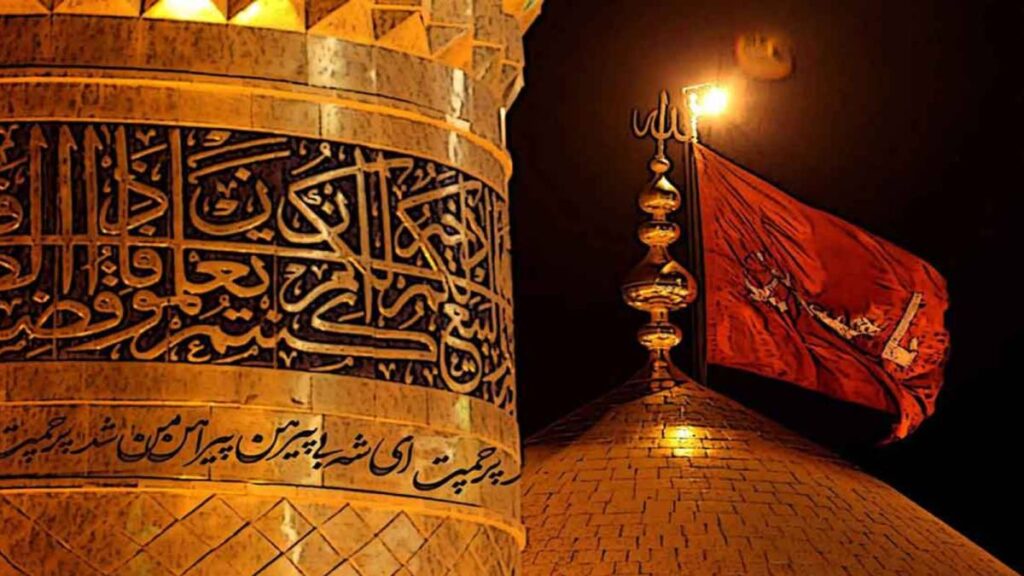
The Sanctuary of Wounded Souls: How Karbala Redefines Human Resilience
If this world has taught you to become hard, then Karbala teaches you to remain gentle—without bowing down, without giving up. It is a profound school of thought that instructs us that tears are not an embarrassment, grief is not a weakness, and even after being deeply wounded, the human heart can remain wide open. This sanctuary is not built for those who have never broken; rather, it is uniquely carved for those who loved so deeply that they received equally profound wounds. Yet, despite the scars, Karbala welcomes them entirely into its embrace.
Therefore, if your heart is fractured, the call of Karbala is a call to return. It invites you to come exactly as you are—bringing along your grief, your silence, your regrets, your exhaustion, and your unfulfilled aspirations. It asks you to carry those shattered pieces of your existence that have become far too heavy to bear alone. Karbala does not demand perfection or spiritual completeness before offering its boundless mercy; it only requests that you do not close the door to your own heart. In this sacred space, there is eternal room for every wounded soul.
The Transmutation of Pain
When one pauses to reflect within this space, a profound realization emerges: the tragedy that broke you does not simply vanish or end in despair. Instead, it transmutes. It takes on an entirely new form, evolving into a prayer, standardizing into a cherished memory, and ultimately carving out a gentler, more courageous way of navigating this world. The modern seeker is called to Karbala not to leave their pain behind in oblivion, but to place it reverently beside those historical figures who lived through the absolute zenith of human suffering, yet steadfastly refused to forfeit their core humanity.
For those trapped in the modern epidemic of isolation, where loneliness has become the primary language of existence, walking alongside Imam Hussain (A.S.) offers a profound companionship. There are certain depths of grief that no ordinary human company can lighten. Hussain (A.S.) traversed that exact, absolute isolation. He stood unyielding with the truth at a historical juncture when doing so had become almost entirely unbearable. Yet, he remained steadfast. He refused to diminish his stature just to be accepted by the masses, nor did he dilute the gravity of his truth so that a compromised world might easily swallow it. For the lonely heart, Hussain (A.S.) stands as the ultimate companion—a timeless reminder that being abandoned by humanity does not equate to being abandoned by the Divine.
The Language of Dignity and Witness
Furthermore, if hidden, unvoiced pain has become the defining syntax of your life, Karbala understands that silent dialect. If you have mastered the art of smiling despite agonizing inner turmoil. If you have kept your composure and held your ground while breaking entirely on the inside, If you have learned to survive while quietly carrying the structural ruins of your own heart, Imam Hussain (A.S.) mirrors that exact endurance. Karbala is populated by those who were systematically denied comfort, yet whose ultimate meaning, purpose, and dignity could never be stolen.
This is why broken hearts instinctively gravitate toward this history time and again—not to flee from their current tribulations, but to learn the sacred art of carrying suffering with absolute dignity.
When sheer exhaustion renders the human body too heavy to move and the psychological weight makes walking feel impossible, one is drawn closer to the historic thirst of Karbala. It is an invitation to sit amidst the memory of those burning tents, the swirling desert dust, the agonizing waiting, the distressed children, and the sight of the flowing Euphrates that was so painfully near, yet violently withheld.
Ultimately, Karbala is not a distant, detached myth of invincible, untouchable heroes. It is a visceral, historical landscape where human pain was experienced to its absolute limits, yet personal dignity was never sacrificed on the altar of compromise. If your spirit is tired, Karbala does not demand instantaneous strength from you as a prerequisite for entry. It simply bears witness to your struggle. It looks at the modern weary soul and whispers: “I see your wounds, and I do not turn my gaze away.”
To all who are fractured, the threshold remains open. Bring the grief that finds no words, the silence buried in your chest for years, and the deep wounds whose names no one else knows. Karbala has never belonged to those whose lives were unblemished; it has always been, and will always remain, the ultimate sanctuary for those who reach its gates with a broken heart.