
THE SCHOOLS ARE STILL OPEN
Christopher J. writes about leadership, judgment, responsibility, and institutional trust. Drawing on a career in international affairs and public service, his essays explore how people and institutions make decisions under conditions of uncertainty, constraint, and consequence.
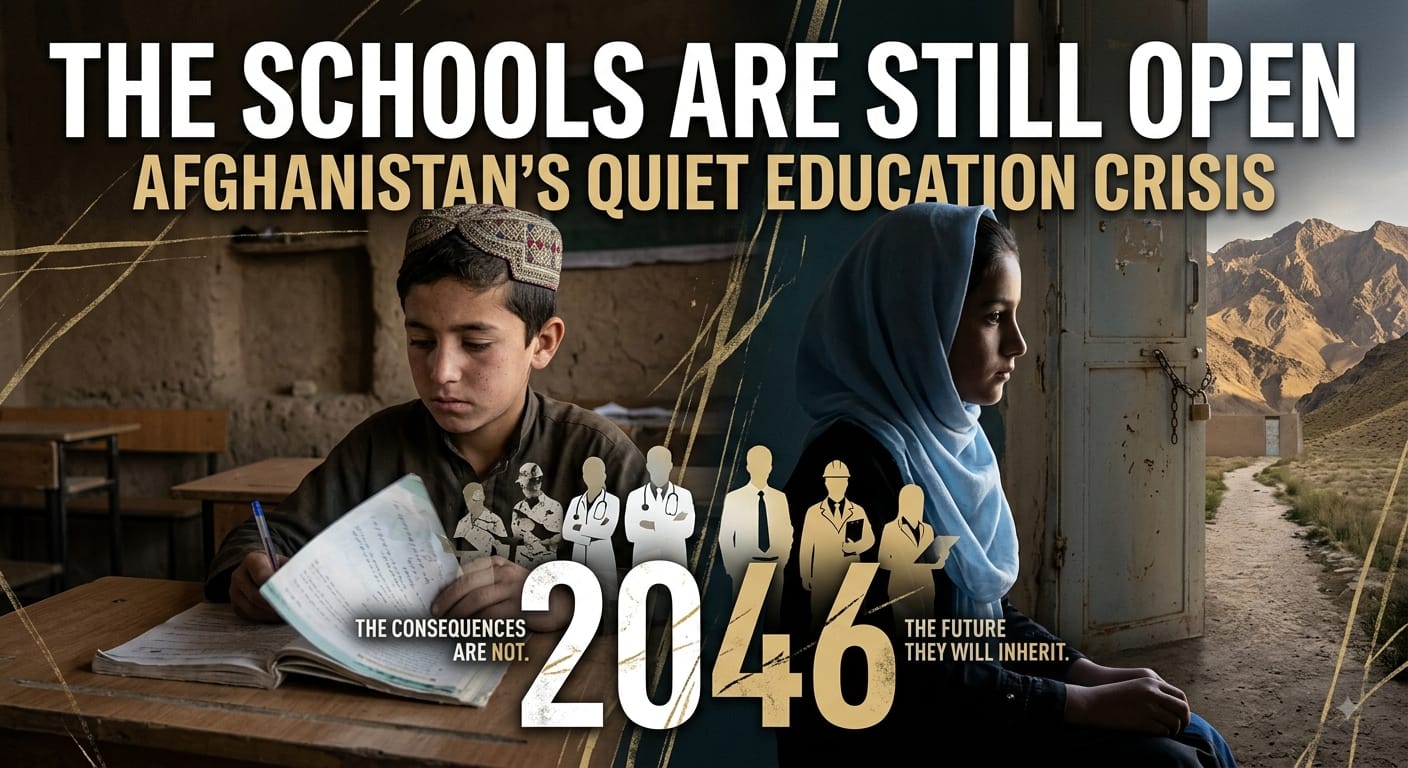
Afghanistan’s schools for boys are still open.
That may be obscuring what is happening inside them.
Five years after the Taliban returned to power, Afghanistan’s education crisis is usually understood through the exclusion of girls and women. More than two million girls have been denied secondary education. Women remain barred from universities.
The consequences of that policy will shape Afghanistan for generations.
But another educational crisis is developing alongside it.
Boys can still go to school.
Increasingly, the question is what kind of education they are receiving when they get there—and what kind of country that education will eventually produce.
UNESCO and UNICEF’s 2025 assessment described a worsening learning crisis across Afghanistan. The latest official estimate, from 2021, found that 93 percent of Afghan ten-year-olds could not read and understand a simple text. The report said no newer official estimate was available, but that learning poverty was believed to remain above 90 percent.
That crisis did not begin with the Taliban. Afghanistan’s schools struggled with quality, resources and access long before 2021.
But other indicators are moving in the wrong direction.
The gross enrollment ratio for boys in secondary education fell from 84 percent in 2018 to 68 percent in 2024. Male university enrollment fell from 310,369 students in 2019 to 188,957 in 2024.
Secondary schools face acute shortages of qualified subject teachers and what UNESCO and UNICEF describe as a near-total absence of essential facilities such as laboratories, libraries and technology.
At the same time, the Taliban are changing what schools are intended to teach.
A revised curriculum was officially adopted in February 2025. Instructional time in languages and social sciences was reduced, while subjects including civic studies and culture were removed at some grade levels. A separate unified curriculum proposed for Grades 1–6 would devote almost half of teaching time to Islamic education, partly by reducing time for mathematics, science and social studies.
The distinction between policy and implementation matters. As of September 2025, UNESCO reported that UNICEF monitoring had not yet detected the planned changes in classrooms nationwide, and implementation of the unified primary curriculum remained limited.
But the direction of policy is increasingly difficult to miss.
Hashmat Mubariz experienced what those numbers and policy documents cannot quite describe.
Before the Taliban returned to power, he remembers his public school as imperfect but relatively open. He studied English, science, mathematics, biology and literature alongside religious subjects.
Students could speak in class.
They could express opinions.
They could ask questions.
After 2021, he watched that environment change.
The Taliban never prohibited Mubariz from attending school as they prohibited his two sisters.
He remained officially enrolled.
But by Grade 11, he had largely stopped going.
“I felt I was wasting my time at school rather than learning,” he said.
Mubariz eventually taught himself English. He became an English instructor and now hosts a podcast and helps run a nongovernmental organization.
His experience cannot tell us what is happening in every Afghan classroom.
But it does not stand alone.
Human Rights Watch interviewed boys and their parents across eight Afghan provinces and documented declining educational quality, reduced attendance, the loss of experienced teachers, subjects being dropped or displaced, greater emphasis on religious instruction and a widespread loss of hope about the future.
The problem is larger than whether school doors remain open.
A country can continue schooling its children while gradually becoming less capable of educating them.
For Afghanistan, that is also a question of national capability.
Doctors, engineers, teachers and administrators require years of education. Once those capabilities exist, they help reproduce themselves: experienced professionals train the people who follow them.
The reverse can happen too.
A weaker education today eventually appears in the people available to teach, administer, build and govern tomorrow.
Infrastructure can be rebuilt. Lost years of education are harder to recover.
That matters because Afghanistan will eventually require those capabilities regardless of who governs it.
The Taliban may still control Afghanistan twenty years from now.
They may not.
Some successor government may emerge. The country’s political structure may change in ways that cannot reasonably be predicted today.
But whatever government eventually exists will inherit the educational consequences of decisions being made now.
It will need people capable of operating ministries, hospitals and universities. It will need engineers to maintain infrastructure, teachers to educate another generation and administrators to govern provinces.
Afghanistan’s neighbors will inherit some of those consequences as well.
Geography will ensure that Afghanistan’s educational future does not remain Afghanistan’s problem alone.
This is why the exclusion of girls from education has consequences extending beyond the rights being denied today.
The girl prevented from completing her education cannot easily become the teacher Afghanistan will need tomorrow.
Or the physician.
Or the engineer.
Or the university professor.
Her absence eventually becomes someone else’s shortage.
The boys’ crisis operates differently.
Boys remain in classrooms, but many are moving through an education system struggling with declining participation, shortages of qualified teachers and an official curriculum moving toward greater emphasis on religious education.
Some of those boys will become teachers themselves.
The two educational crises therefore cannot remain separate indefinitely.
Their consequences will eventually meet.
Which brings us to 2046.
Somewhere in Afghanistan today, an eleven-year-old boy is sitting in a classroom.
He will be thirty-one years old in 2046.
By then, he may be running a business.
Teaching children.
Working in a ministry.
Serving in a provincial administration.
Leading other men.
Raising a family.
The education he receives today will travel with him into all of those places.
So will the education he does not receive.
And somewhere nearby is an eleven-year-old girl.
Her formal education may already be approaching its end.
She too will be thirty-one in 2046.
Perhaps she would have become a physician, teacher or engineer.
Perhaps none of those things.
We cannot know what choices she might have made because many of those choices are being removed before she has the opportunity to make them.
In 2046, those two children will no longer be children.
They will be Afghanistan.
They will staff whatever government exists.
They will operate whatever economy exists.
They will teach the children born in the 2030s and 2040s.
They will run hospitals, businesses, provincial governments, universities and farms.
They will inherit whatever institutions remain.
And they will inherit one another.
None of this means Afghanistan’s future has already been determined.
Afghans have repeatedly demonstrated an extraordinary ability to learn, adapt and build under extraordinarily difficult circumstances. Mubariz himself demonstrates that.
But his achievement also illustrates the limits of individual resilience.
A country cannot depend upon every seventeen-year-old teaching himself what his school no longer provides.
Foreign policy tends to operate on a much shorter clock than education.
Governments respond to wars, terrorist attacks, refugee movements, humanitarian emergencies and political crises. Their consequences become visible quickly enough to demand attention.
Educational decline operates differently.
The school building may still be standing. The teacher may still arrive. The students may still be enrolled.
From the outside, almost everything can appear to remain in place.
The international community may eventually turn its attention elsewhere.
The children will continue growing up.
In 2046, the world will not be dealing with the children sitting in Afghanistan’s classrooms today.
It will be dealing with the country they are running.
The schools will have remained open.