
The Strategy That Takes Decades
Christopher J. writes about leadership, judgment, responsibility, and institutional trust. Drawing on a career in international affairs and public service, his essays explore how people and institutions make decisions under conditions of uncertainty, constraint, and consequence.
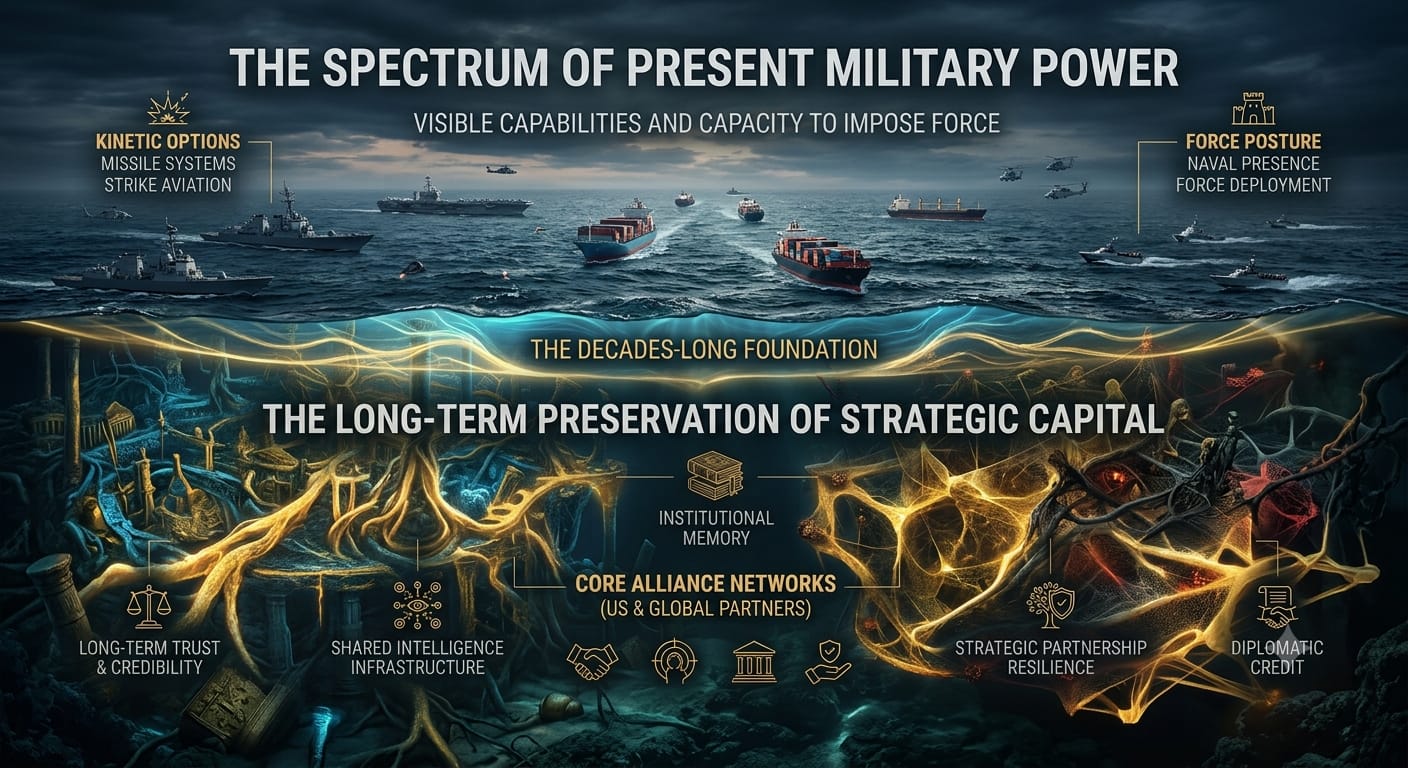
Military power determines what states can do. Accumulated strategic capital often determines how long they can continue doing it. Those who spend enough time in national security eventually recognize that strategy is accumulated long before it is employed.
Wars reveal it.
Crises test it.
Victory and defeat often depend upon it. Most of the work, however, happens quietly over decades. Analysts naturally focus on visible capabilities. They count ships, aircraft, missile inventories, troop strength, and defense spending. Those measurements matter because they describe what governments possess at a particular moment.
States often ask a different question. What strategic advantages have been accumulated that cannot be recreated quickly? The answer extends far beyond military equipment. It includes relationships built over decades, political credibility earned through repeated crises, and institutional knowledge that survives individual careers.
Some agreements become routine. Others quietly become indispensable. Together, they form accumulated strategic capital. Like financial capital, it grows through sustained investment. Unlike financial reserves, however, it cannot be assembled once the crisis begins. It has to exist before the first decision is made.
It is built one interaction at a time. Every combined exercise. Every intelligence exchange.
Every difficult negotiation that ends with both sides honoring their commitments. Eventually, coordination becomes routine because trust no longer has to be negotiated from the beginning. The Strait of Hormuz offers a useful illustration. It is often described as the world’s most important maritime chokepoint.
Geography explains the vulnerability.
Global commerce, however, has continued flowing through the Strait despite decades of regional instability.
That resilience rests on an enormous reserve of strategic capital. For decades, the United States and its regional partners built military relationships, intelligence cooperation, logistical infrastructure, and habits of political coordination that continue to support maritime security even under extraordinary pressure.
Those relationships were available precisely because they already existed.
During periods of tension, commanders often discover that the most valuable asset on the map was negotiated years before anyone expected it to matter. Iran understands this reality as well. Iran is often evaluated through its missiles, drones, naval forces, and anti-ship capabilities. Those are only part of its leverage. Iran has spent decades accumulating its own strategic capital. The Islamic Revolutionary Guard Corps has developed operational experience in Gulf waters. Intelligence networks have matured. Proxy relationships have expanded regional influence. Coercive credibility has been reinforced through repeated demonstrations of capability and a willingness to impose costs.
Even uncertainty has become an instrument of statecraft. None of that can be measured simply by counting launchers or patrol boats. The competition surrounding Hormuz is therefore larger than a contest between opposing military capabilities. It is a contest between two reservoirs of strategic capital. Wars consume equipment far faster than they erase institutional memory, trusted relationships, or strategic credibility.
Winning a battle may alter the military balance. Preserving those accumulated advantages often shapes the balance that remains after the war ends. That distinction matters because wars are often misunderstood.
They do not simply determine which side possesses greater military power. They also reveal which side protected more of what took decades to build. Strategic capital extends well beyond military organizations.
NATO’s strength rests on more than military capability. Its deterrent value is rooted as much in political confidence as in military power. China’s growing influence across the Indo-Pacific reflects years of diplomatic engagement, infrastructure investment, and steadily expanding regional relationships. Even weakened proxy organizations may retain strategic value because they embody political access, local knowledge, and operational experience accumulated over many years.
This helps explain why states preserve institutions that appear diminished. It also explains why alliances that seem expensive during periods of peace often become indispensable once crises begin. Military power determines what states can do. Accumulated strategic capital determines how long they can continue doing it.
The first can often be built relatively quickly. long they can continue doing it. The first can often be built relatively quickly.
The second almost never can.