
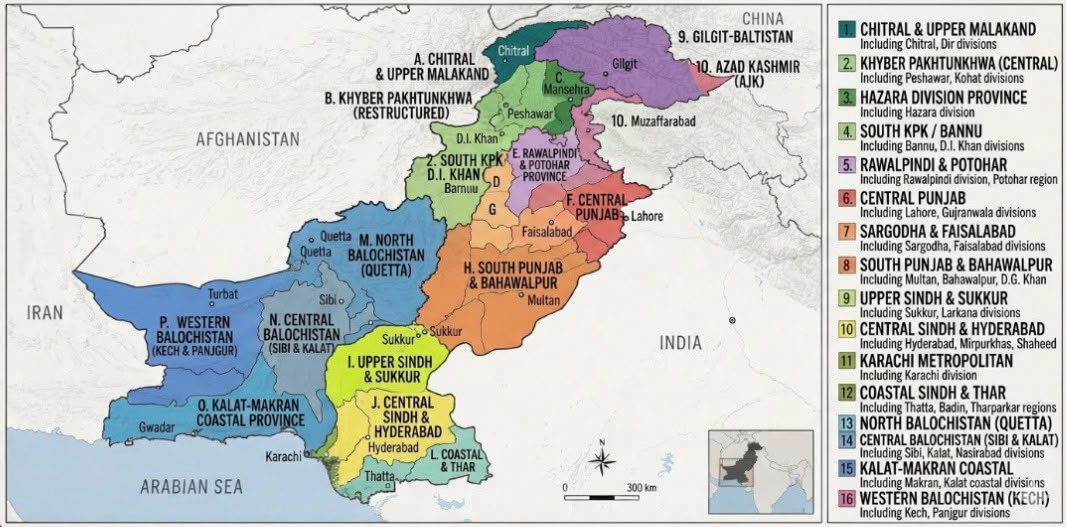
Transferring powers to the lower level or creating smaller administrative units is certainly an elixir, but talking about creating new provinces is definitely a new potion. The elixir or the great elixir is that imaginary medicine that can cure all diseases. Giving powers to the district or division after the center and the province can bridge the gap between the government and the people. “Pawada” is a famous Punjabi word that means to throw a potion, to cause a dispute or to create a problem. Talking about new provinces is tantamount to throwing a potion. This issue is a controversial issue like the construction of Kalabagh Dam and canals. The ancient inhabitants of Sindh are strongly against the division of the province. At present, there is no major opposition to the division of Punjab into several provinces, but the strong objection to the PPP is that you are against the division of Sindh and are in favor of the division of Punjab. Rather, you have already divided your party organization into southern and central Punjab, which is a clear policy contradiction. PML-N, Tehreek-e-Insaf and even Jamaat-e-Islami are also sitting in their respective parties dividing Punjab into different parts as if the iron is hot only in Punjab which can easily be hurt in the province of Punjab. Balochistan Chief Minister Sarfraz Bugti is openly against the division of Balochistan. How can the elements who merged Khyber Pakhtunkhwa with the tribal areas till yesterday talk about dividing it into provinces after only a few years?
The case of Punjab is different from all others. It seems that it is the easiest to turn Punjab’s nose. But remember that Punjab’s response comes late and when it comes, it changes everything. The historical fact is that Punjab came into existence as an independent country 182 years before Pakistan became a country when the Sikhs captured Lahore in 1765. Since then, Punjab became an independent country. Historically, the identity of Punjab is older than all the provinces. Believe it or not, the most powerful shield of Pakistan is Punjab and the brave soldiers of Punjab are making the most sacrifices for the defense and stability of Pakistan. The division of Punjab will cause a hole in the defense shield and weaken the identity of the strongest army. Punjab sacrificed its identity, language and culture for Pakistan so that Pakistan would become strong. But remember, the division of Punjab will promote Punjabi nationalism in this province, which is currently completely missing, but its seeds are definitely present somewhere in the hearts and can become a crop at any time.
PML-N is a Punjab-centric political party. This year, it has agreed to take about 500 billion less than the federal government from the development budget. If it accepts the division of Punjab into several provinces, its power will be weakened and its politics will be weakened. PTI has also been taking a majority from Punjab. If it supports the division of Punjab, many regional parties will eliminate it. Punjab is already angry with the PPP because of its Sindh-centric policy. It is as if political parties, if Punjabis are mistakenly ignored and ignored, then these sleeping lions should not wake up and raise the slogan of Jag Punjabi Jag.
Be it a country or a province, a city or a village, everyone is connected to their history, culture and geography. Changes made in history, culture and geography by force are not sustainable and their reaction is dangerous. It seems that the referendum is ready. The real problem will be the question. If the question of creating provinces is raised, a new foundation will be laid, and if the question of transferring new administrative units or powers to the divisional or district level is raised, it will be an nectar flow. Referendums have a bad reputation historically. Let’s pray that this time the referendum becomes the basis of an nectar flow and not a new foundation…!!
Major Historical Referendums in Pakistan
Article 48(6): Empowers the President of Pakistan—on their own initiative or on the Prime Minister’s advice—to refer any matter of national importance to a public referendum in the form of a simple yes/no question.
1984 Referendum: Held on December 19, 1984, by military ruler General Zia-ul-Haq.
2002 Referendum: Held on April 30, 2002, by military ruler General Pervez Musharraf.
asked the public to extend his tenure as President for another five years, resulting in a declared “yes” victory amid political controversy