
Christopher J. writes about leadership, judgment, responsibility, and institutional trust. Drawing on a career in international affairs and public service, his essays explore how people and institutions make decisions under conditions of uncertainty, constraint, and consequence.
What Another Promise Would Leave Unanswered
The Taliban have made commitments before. The question now is what they are prepared to do to fulfill them.
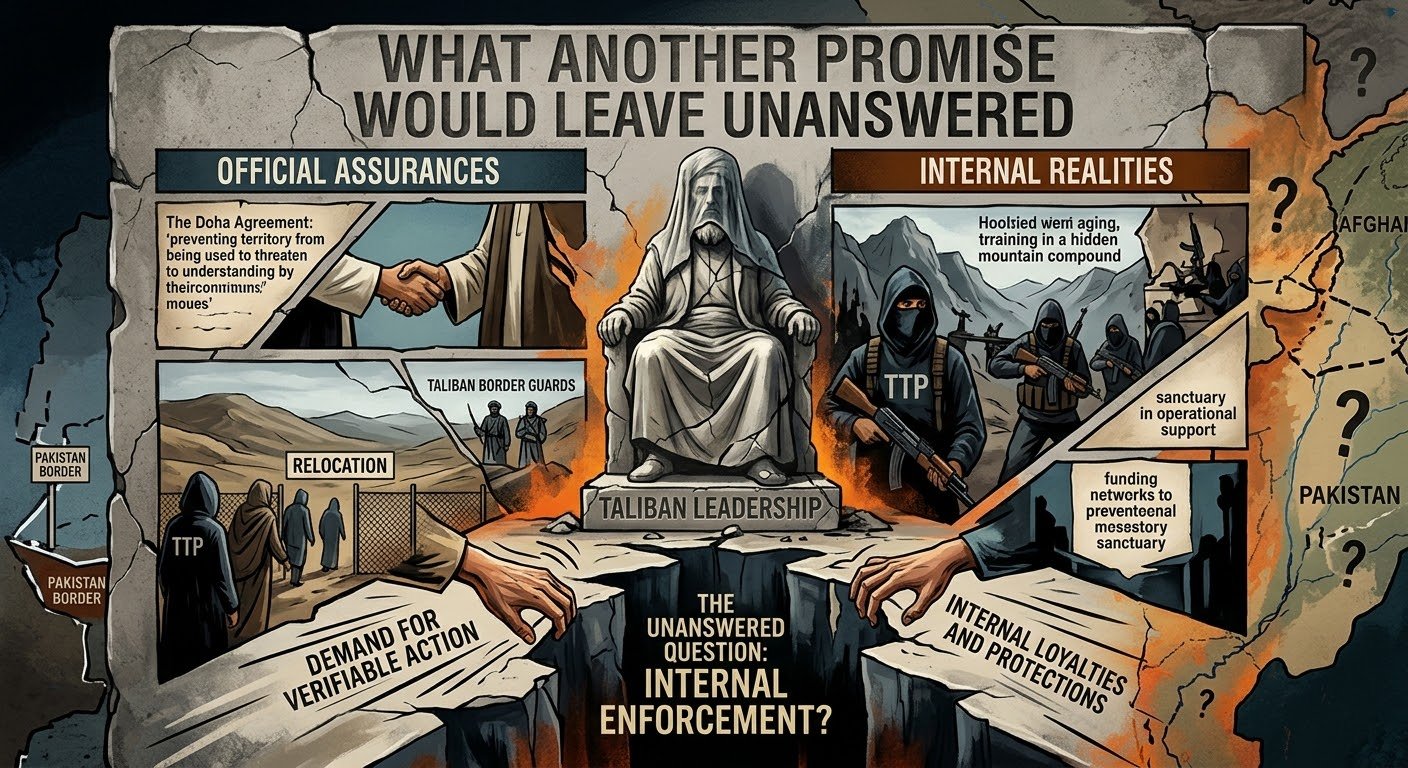
In February 2020, the Taliban agreed to prevent Afghan territory from being used to threaten the United States and its allies. The Doha agreement included provisions concerning recruitment, training, fundraising, and the hosting of individuals or groups posing those threats, including al-Qaeda. Those commitments formed part of an agreement providing for the withdrawal of foreign forces.
Doha was not a guarantee covering every country. An attack against Pakistan does not, by itself, establish a breach of its terms. But the agreement demonstrates that Taliban leaders accepted responsibilities requiring more than assurances.
Pakistan now demands verifiable action against militants it says operate from Afghanistan. Kabul denies providing sanctuary and rejects responsibility for Pakistan’s insecurity.
In its December 2025 report, the United Nations sanctions monitoring team described continued Taliban harboring of the leadership of the Tehrik-e-Taliban Pakistan (TTP) and facilitation of its operations. Some senior Taliban figures increasingly regarded the TTP as a liability in relations with Pakistan; others remained supportive. The report questioned whether the Taliban could act effectively against the organization even if its leadership chose to do so.
U.S. inspector general reporting for July through December 2025 also recorded Taliban efforts to restrict TTP recruitment and training and preempt attacks against Pakistan. The Defense Intelligence Agency assessed that enforcement was uneven and would probably have a limited effect on the pace of attacks over the following three months. The report for April through June 2026 described continued Taliban sanctuary for TTP members, which the agency assessed likely contributed to persistent attacks in Pakistan.
The UN monitoring team’s August 2026 report added an important detail. Taliban authorities had reportedly relocated approximately 2,000 TTP fighters and family members away from the Pakistani border. Taliban leader Hibatullah Akhundzada had also reportedly warned TTP leaders to halt attacks against Pakistan or risk losing support.
Yet the same assessment described continued Taliban support for the TTP.
Restrictions imposed by some officials may coexist with protection provided by others. A leadership decision may be announced without being enforced across the movement. Measures intended to reduce immediate tensions may leave an organization’s command structure and operational capabilities largely intact.
Acting decisively against the TTP would require Taliban leaders to confront relationships and loyalties within their own ranks. That difficulty may explain some of the uneven enforcement.
Evidence supporting Pakistan’s demand for action does not establish that every Pakistani strike was necessary, proportionate, or conducted with adequate protection for civilians.
Those questions require their own examination.
Nor can Taliban compliance be measured solely by whether attacks continue. No government can guarantee that every attack will be prevented. The more useful examination concerns what has actually changed. Have recruitment and training become more difficult? Have financing and logistical networks been disrupted? Are commanders losing access to sanctuary and operational support? Are restrictions being enforced when influential Taliban figures oppose them?
Relocating fighters, issuing warnings, and imposing restrictions may represent genuine efforts. Their significance depends on whether they reduce the TTP’s ability to organize and operate.
What remains uncertain is whether Taliban leaders are prepared to enforce restrictions against those within their own movement who continue to protect the TTP.
Another promise would leave that question unanswered.
This article draws exclusively on publicly available documents and reporting. The analysis and conclusions are my own.