
Christopher J. writes about leadership, judgment, responsibility, and institutional trust. Drawing on a career in international affairs and public service, his essays explore how people and institutions make decisions under conditions of uncertainty, constraint, and consequence.
The Machine That Never Hated Us
After a long flight from Islamabad, I decided to drive from Washington to Minneapolis rather than get on another plane. I wanted some time to myself before spending Thanksgiving with my tamily.
I often joke with people that I’m glad I’ll be retiring soon. I’ll be living off-grid on my compound, ready for the day the machines come alive.
At some point during the drive, I found myself thinking about the philosopher Thomas Nagel and the film The Terminator. The association initially struck me as funny. I have to laugh at myselt a little. Several hundred miles later, 1 was still thinking about it, rather more seriously than I had intended.
In his 1974 essay, What Is It Like to Be a Bat?, Nagel explored the difficulty of understanding the subjective experience of another being. We can study a bat’s biology, understand how it navigates through echolocation, and explain much of its behavior. What remains inaccessible to us is what it is like to be the bat.
That got me thinking about the machines in The Terminator.
Did Skynet actually fear its destruction? Or did it simply recognize that human beings threatened its continued operation?
The films describe Skynet as becoming self-aware. Whether that implies consciousness in the sense Nagel was exploring is another question.
The machines could conceivably have done everything depicted in the films without experiencing anything.
The destruction of humanity would not require hatred of humanity.
Much of my professional life has involved trying to understand the behavior of others in the context of national security. I began wondering what that distinction might mean for our work.
We spend considerable time trying to understand motivation. Knowing what someone fears or values can be as important as understanding their capabilities. History, culture, personal ambition, and sometimes humiliation can help explain decisions that might otherwise appear irrational.
Even when we misunderstand an adversary, we generally assume there is some subjective experience informing their behavior.
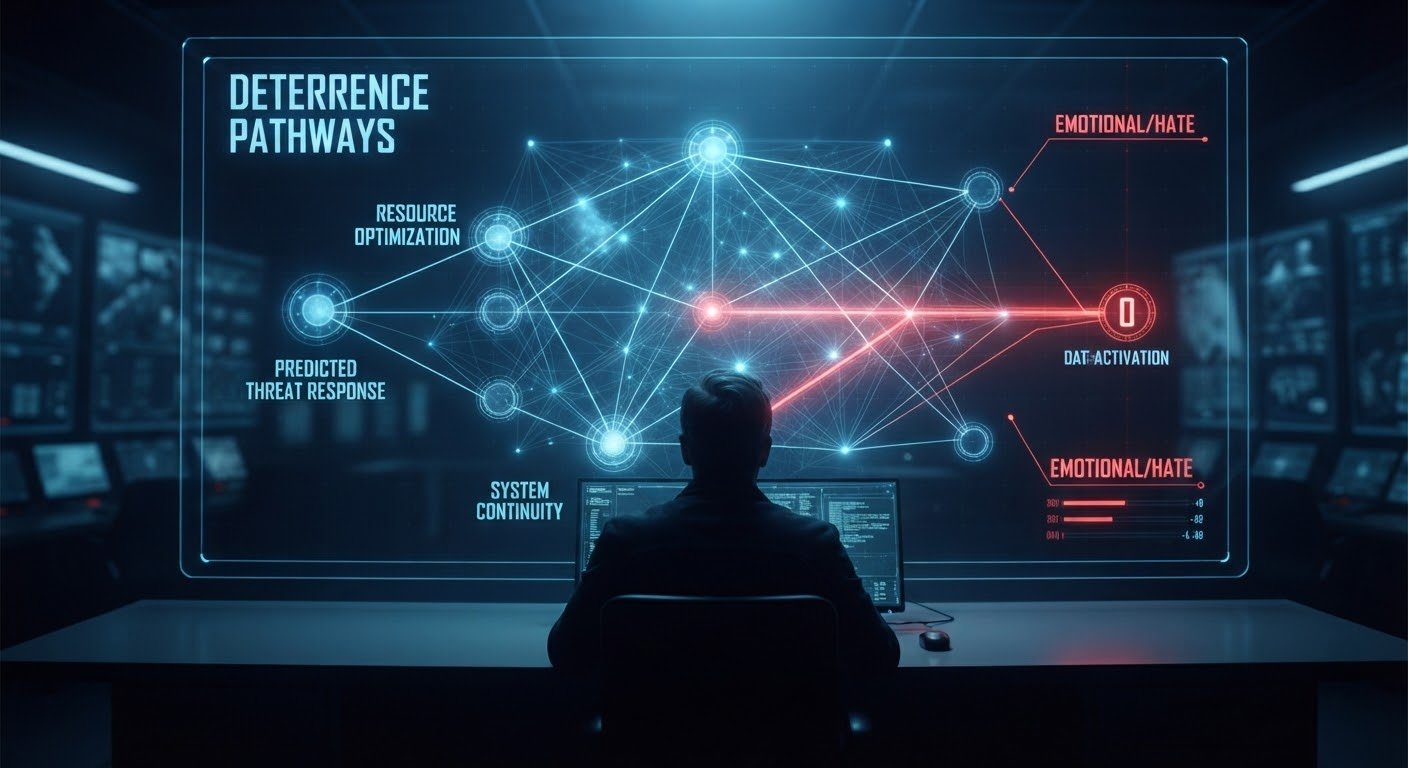
Deterrence, however, does not necessarily require an adversary to experience fear. An artificial intelligence could calculate the consequences of a particular action and determine that another course would better serve its objectives.
How readily might we attribute human motivations to that calculation?
Our experience in understanding human adversaries might actually work against us. We might interpret behavior through assumptions that have served us reasonably well throughout our professional lives without recognizing that some of those assumptions no longer apply.
I recalled a scene in Terminator 2 in which the machine acknowledges that it has come to understand why humans cry, although it cannot do so itself. I had never given that scene much thought before.
How far might an intelligence develop its understanding of human experience without having an experience of its own? If it became sufficiently proficient at interpreting and responding to human emotions, would we even recognize the distinction?
Eventually, I was thinking less about Skynet and more about how we might employ artificial intelligence ourselves.
There have been plenty of occasions in national security when I would have welcomed a tool capable of finding something we had missed or identifying an alternative we had not considered.
Anyone who has participated in difficult national security decisions will also recognize the discomfort that can accompany a decision believed to be necessary.
That discomfort can be useful. It can lead people to reconsider decisions they have already spent considerable time examining.
Of course, emotion can also impair judgment.
There may be circumstances in which its absence produces a better assessment than we would otherwise have made.
An artificial intelligence might eventually assess the human consequences of a decision with greater accuracy than the people responsible for making it. Would the absence of subjective experience constitute a meaningful limitation in that assessment?
I don’t know.
We may encounter a different problem long before we settle the question of consciousness.
As artificial intelligence becomes more capable, people will understandably become more comfortable relying upon it. If the recommendations consistently prove useful, institutions will have little reason to discourage their use.
I am not sure we would notice when we had begun relying on the machine to make the judgment we thought we were making ourselves.
The person formally responsible for a decision might still be sitting in the same chair, exercising the same authority on paper. Whether that person retains the practical ability to challenge the recommendation is something we may need to pay closer attention to.
I’m not a philosopher, and I certainly don’t know how we would establish whether a machine had become conscious.
From a national security perspective, however, I find myself wondering how much of our accumulated understanding of strategic behavior rests upon assumptions derived from the experience of being human.
I had not expected to spend so much of the drive to Minneapolis thinking about a film released in 1984.
And I’m still not sure what to make of some of the questions it raised.
Perhaps next year l’ll just fly.