
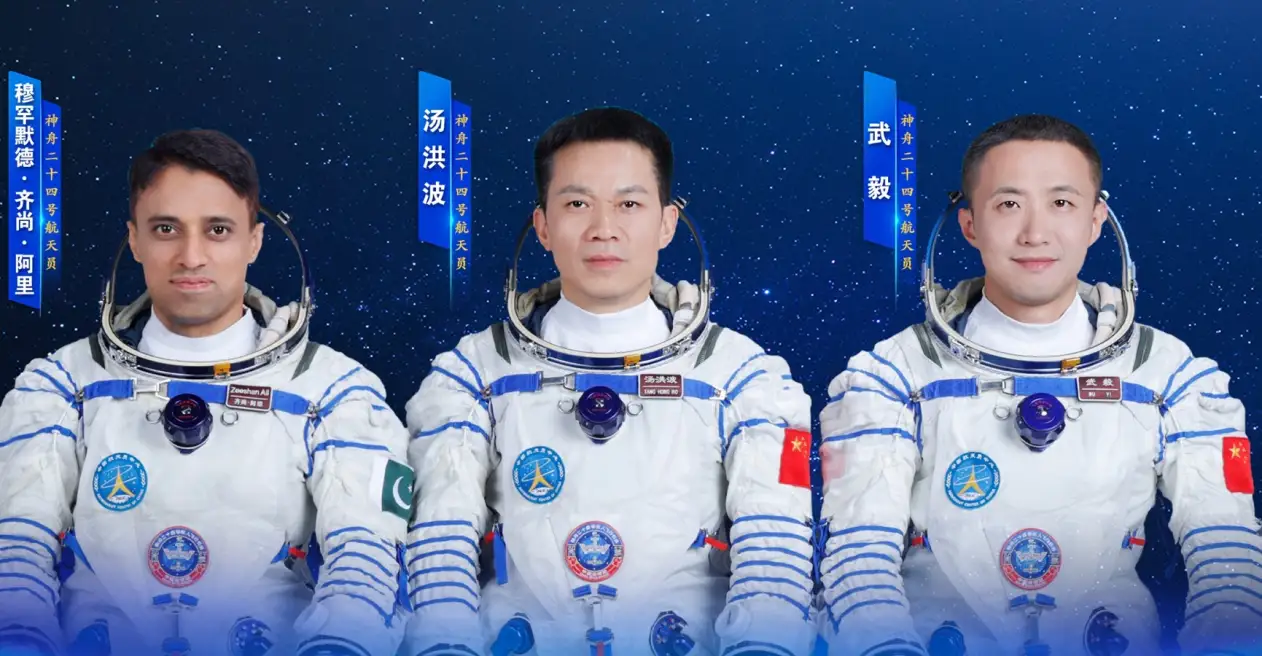
Beijing, Clear Skies Magazine, Pakistan is about to make space history. China’s Shenzhou-24 crewed spaceship is scheduled to launch at 8:18 a.m. Beijing Time (5:18 a.m. Pakistan Standard Time) on Wednesday, 25 November 2026, from the Jiuquan Satellite Launch Center in northwest China. On board will be Pakistani astronaut Muhammad Zeeshan Ali, who will become the first foreign astronaut ever to visit China’s space station.
The China Manned Space Agency (CMSA) announced the launch on Tuesday. CMSA spokesperson Zhang Jingbo told a press conference that the Long March-2F carrier rocket for the mission will soon be filled with propellant.
Shenzhou-24 Mission Marks a Double First
The Shenzhou-24 mission is a milestone for China’s manned space programme as well as for Pakistan. For the first time in the programme’s history, Chinese and foreign astronauts will fly together, and China’s space station will host a foreign astronaut for the first time.
Zhang called it another landmark achievement in bilateral cooperation as China and Pakistan celebrate the 75th anniversary of diplomatic relations, and an important reflection of the traditional friendship between the two countries.
Meet the Shenzhou-24 Crew
The Shenzhou-24 crew is made up of three astronauts:
Tang Hongbo (spacecraft pilot): A veteran of the Shenzhou-12 and Shenzhou-17 missions, he is set to become the first astronaut to visit China’s space station three times.
Wu Yi (flight engineer): From China’s third batch of astronauts, he will make his first spaceflight.
Muhammad Zeeshan Ali (payload specialist): Pakistan’s astronaut and the first foreigner to visit China’s space station.
Shenzhou-24 is the eighth crewed mission of the application and development stage of China’s space station, and the 41st flight mission of China’s manned space programme.
All Systems Go for Launch
Zhang said the spacecraft and launch vehicle are in good condition, the crew is ready, ground facilities and equipment are operating stably, and the space station complex is functioning normally. All systems are ready for the launch.
After reaching orbit, Shenzhou-24 will use an autonomous rapid rendezvous and docking strategy. It will dock with the forward port of the Tianhe core module, forming a three-spacecraft, three-module combination.
Muhammad Zeeshan Ali’s Mission in Space
Muhammad Zeeshan Ali will fly a short-duration mission. Along with joining the crew’s daily activities, he will mainly be responsible for China–Pakistan joint space science experiments. His work will focus on installing experimental samples and equipment and carrying out the planned experiments in orbit.
He will also conduct an experiment with photosynthetic cyanobacteria in orbit. After completing the joint mission, he will return to Earth aboard the Shenzhou-23 spacecraft.
90 Experiments, Including Four China–Pakistan Projects
A total of 90 scientific experiments and technology tests are planned for the Shenzhou-24 mission. They cover:
space life sciences
space materials science
microgravity fluid physics and combustion science
fundamental physics
space medicine
new space technologies
These include four joint China–Pakistan scientific projects focused on biotechnology and materials science.
One Astronaut to Stay in Orbit for a Full Year
One member of the Shenzhou-23 crew will remain in orbit for a one-year stay experiment. Based on current assessments, the mission command headquarters has chosen astronaut Zhu Yangzhu for the year-long stay. After the crew rotation, Tang Hongbo, Wu Yi and Zhu Yangzhu will stay aboard the space station.
Shenzhou-23 Crew Delivers Breakthrough Results
Since entering the space station on 25 May, the Shenzhou-23 crew has carried out a series of experiments with support from ground teams and achieved phased results in four areas:
Space life sciences: Researchers found that spaceflight reduces the differentiation efficiency of human induced primordial germ cells by about 50%.
Materials science: A millimetre-scale deep-ultraviolet nonlinear crystal was grown in orbit for the first time, with improved growth and quality.
Space medicine: New technologies enabled muscle imaging, blood protein detection and non-contact monitoring of astronauts’ physiological data, while AI models helped assess exercise loads and fatigue.
Space technologies: Semi-solid-state batteries completed their first in-orbit tests, laying the groundwork for future upgrades to energy systems on the space station and in lunar exploration missions.
Li Jiaying, the first astronaut from China’s Hong Kong Special Administrative Region to travel to space, served as payload specialist on Shenzhou-23. She completed her tasks in space science research, technology tests and science outreach. During a spacewalk, she operated the robotic arm from inside the station to support crewmates Zhu Yangzhu and Zhang Zhiyuan. She also joined her crewmates as a “space teacher” in a special “Tiangong Class” for Hong Kong and Macao.
Why It Matters
For Pakistan, Muhammad Zeeshan Ali’s flight is a moment of national pride and a major step for the country’s space ambitions. For China, opening its space station to a foreign astronaut for the first time signals a new era of international cooperation in orbit. Coming in the 75th anniversary year of diplomatic relations, the Shenzhou-24 mission takes the China–Pakistan friendship, often described as “higher than the mountains”, all the way into space.