
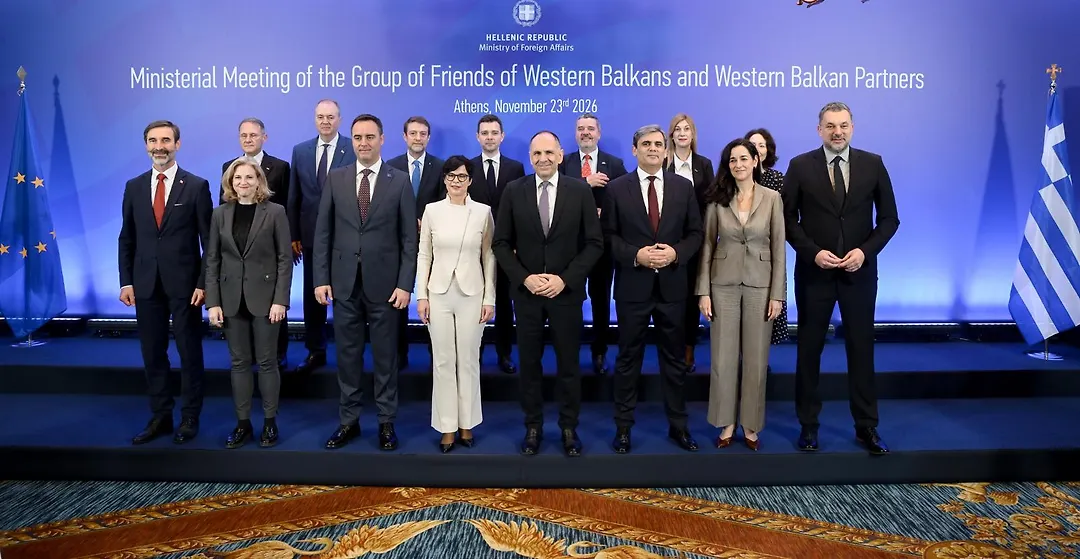
Athens, Clear Skies Magazine: Bosnia and Herzegovina’s Foreign Minister Elmedin Konaković has warned the European Union in unusually blunt terms that the country’s European path has been frozen since March 2024. He said Brussels had let down pro-European politicians in Republika Srpska, while Milorad Dodik, whom he called a man under the complete control of Vladimir Putin, blocks reforms with open support from Moscow.
Konaković made the remarks on November 23, 2026, at the meeting of foreign ministers of the Group of Friends of the Western Balkans in Athens. The meeting focused on European Union enlargement and support for reforms across the region.
Montenegro and Albania Advance, Bosnia and Herzegovina Stands Still
At the session on enlargement, Konaković welcomed the progress made by Montenegro and Albania. He then said that Bosnia and Herzegovina had made no real progress since the EU decided to open accession negotiations in March 2024.
He said the European Union is central to Bosnia and Herzegovina’s economy, since most of the country’s exports go to EU member states. Closer integration, he said, would create new jobs and give young people more reasons to build their future at home rather than abroad.
“A Missed Opportunity” in Republika Srpska
Konaković’s sharpest criticism was about how the EU dealt with Republika Srpska. He said some Serb political representatives had been ready to back European reforms and pass the four laws needed to formally start negotiations with the EU, despite strong political pressure and attacks.
He said Brussels never gave these politicians the support they needed. In his view, the EU missed a chance to strengthen pro-European actors and the reform process in the country. Russia, by contrast, has openly backed political forces that oppose Bosnia and Herzegovina’s European future.
He called on the EU to give concrete support to pro-European politicians, parties and processes in Bosnia and Herzegovina, and to stop limiting itself to statements in favour of European integration.
Dayton’s Loopholes and the Dodik Factor
The minister said the 1995 Dayton Agreement ended the war but left politicians many ways to block reforms. He accused Milorad Dodik of using these mechanisms, with Moscow’s backing, to halt Bosnia and Herzegovina’s progress towards the EU.
Konaković recalled that Bosnia and Herzegovina had once asked EUFOR to help arrest Dodik, who was then a fugitive. The European Union turned down the request, calling it a political matter.
He said the EU can still play a more active role and show resolve against political blockades and outside interference, especially from Russia. As an example, he pointed to the blocked Growth Plan. Because of the blockade, Bosnia and Herzegovina is not using the European funds available to it, and is instead considering borrowing on international markets at much higher interest rates.
Ukraine Comparison
Konaković said negotiations cannot succeed unless the EU responds clearly to political obstruction. Simply urging an agreement with Dodik will not work, he said, in the same way that Ukraine cannot be expected to reach a deal with Putin to end the war without proper political and institutional support.
Elections, Courts and the Sejdić-Finci Rulings
At a second session, on the work of the OSCE Office for Democratic Institutions and Human Rights (ODIHR), Konaković stressed the importance of electoral integrity, an independent and efficient judiciary, the fight against corruption and the protection of fundamental rights. He called for the judgments of the European Court of Human Rights to be implemented, including the Sejdić and Finci cases, so that all citizens have equal political rights.
He called for more structured cooperation between the ODIHR, the European Union and domestic institutions, with expert support for reforms and for carrying out recommendations. He also said that responsibility for reforms lies with Bosnia and Herzegovina’s own institutions.
All Eyes on the EU-Western Balkans Summit
Konaković said he expected the EU-Western Balkans summit on November 25 to confirm the commitment to enlargement and agree concrete steps to speed up the region’s path into the European Union. For Bosnia and Herzegovina, his message in Athens was that the EU needs to do more than talk about enlargement and actively confront those blocking it.