
Islamabad Memorandum
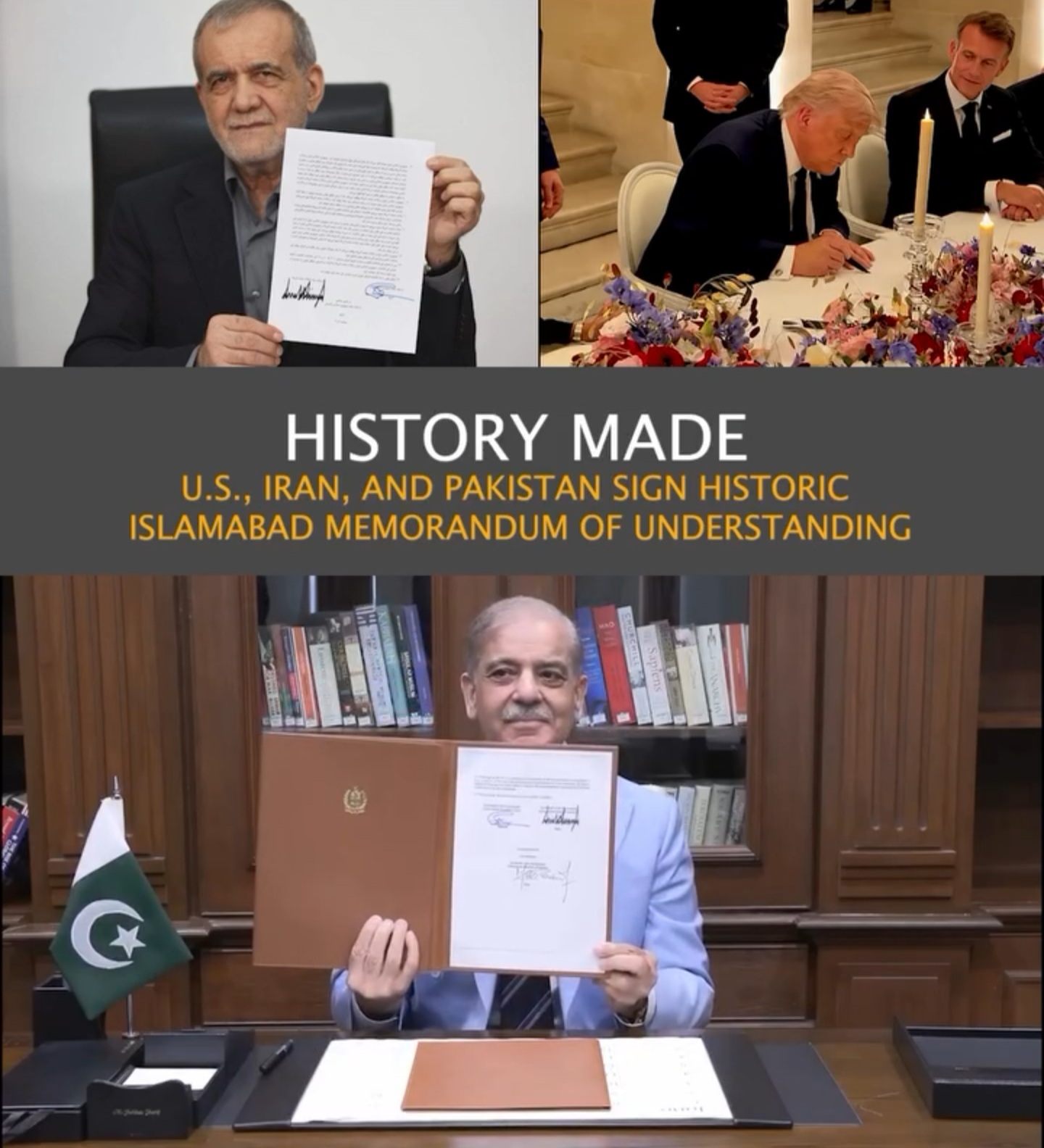
The Islamabad Memorandum of Understanding (MoU) signed on June 17, 2026, by US President Donald Trump and Iranian President Masoud Pezeshkian, has permanently halted the devastating 2026 Iran-US war, marking a monumental shift in 21st century geopolitics.
Brokered through intense nonstop Pakistani mediation, the 14-point framework successfully defused a conflict that had crippled the global economy and threatened a total Middle Eastern meltdown. The key operational takeaways are immediate ceasefire: Establishing an absolute and permanent cessation of all military operations. Economic resuscitation: Reopening the strategic Strait of Hormuz to toll free commercial shipping and lifting the crippling US naval blockade on Iranian ports. The diplomatic runway: Initiate a strict 60 day window to negotiate a permanent treaty covering the highly volatile issues of sanctions relief and nuclear monitoring, leverage US oil waivers to inject immediate liquidity into Iran, while backloading a massive $300 billion economic development package as explicit leverage for final treaty compliance & sidestep protracted enrichment debates by enforcing immediate, verifiable in-situ dilution of stockpiled material under direct IAEA oversight, neutralizing the immediate breakout threat.
By positioning itself as the indispensable backchannel, Pakistan has pulled off an extraordinary diplomatic coup, Pakistan’s successful mediation of the recent crisis redefined its role from a regional bystander to a pivotal diplomatic heavyweight. This agreement doesn’t just stop a war, it fundamentally alters the geopolitical chessboard, proving that even the most entrenched adversaries can be brought to the table when the stakes are high enough and the mediation is relentless. By engineering a critical ceasefire and orchestrating high-stakes negotiations, Islamabad broke a catastrophic international stalemate through sheer diplomatic endurance and strategic leverage.
On April 8, 2026, Pakistan secured a foundational two-week ceasefire. This was not just a humanitarian pause; it was a calculated tactical move that created the necessary political space to force both factions to the negotiating table. Hosted at the Serena Hotel during the Islamabad Talks (April 11–12, 2026), a triumvirate of Pakistan’s top leadership, Prime Minister Shehbaz Sharif, Field Marshal Asim Munir, and Foreign Minister Ishaq Dar, led a grueling 21 hour marathon session. Pakistani mediators utilized a sophisticated, iterative process, systematically moving the hostile delegations from tense, indirect proximity to direct, face to face negotiations.
The reason Islamabad succeeded was Pakistan’s leverage did not rely on economic coercion, but on unique geopolitical advantages, Geopolitical equilibrium: Islamabad capitalized on its rare, dual channel credibility with both Washington and Tehran, positioning itself as a mutually trusted interlocutor where other global powers faced gridlock. Regional coalition anchoring: Rather than operating as a lone wolf Pakistan synthesized a broader diplomatic front by aligning with Saudi Arabia, Qatar, Egypt, and Turkey, ensuring the peace framework carried absolute regional legitimacy. By delivering a signed memorandum, Islamabad proved it possesses a rare commodity; simultaneous high level trust in both Washington and Tehran. It succeeded precisely because it didn’t try to impose an agenda, acting instead as a reliable, secure conduit when direct communication was politically impossible.
The immediate aftermath elevates Pakistan’s diplomatic capital. For now, neither the U.S. nor Iran can easily bypass Islamabad, because it holds the keys to the communication channels that prevented open conflict. The signing of the Islamabad Memorandum has averted a catastrophic US-Iran escalation, positioning Pakistan as an indispensable heavyweight in global conflict resolution. By providing the diplomatic sanctuary needed to halt missile strikes and naval blockades, Islamabad didn’t just protect its own borders, it fundamentally rewrote the rules of Middle Eastern diplomacy. The breakthrough drew immediate high-level praise from, United Nations Secretary General António Guterres expressed his ‘deep appreciation to Pakistan’ for its constructive, central role in preventing a wider global catastrophe.
Turkish President Recep Tayyip Erdoğan lauded Islamabad’s ‘exceptional mediation efforts’ while the state of Qatar formally extended its gratitude to ‘our brothers in the Islamic Republic of Pakistan’. From Canberra to Paris, world leaders have echoed these sentiments, signaling broad international consensus on Pakistan’s statecraft, recognizing that Pakistani soil provided the sanctuary where peace could finally be envisioned. By successfully steering Washington and Tehran away from total war, Islamabad has transitioned from a regional player to a vital pillar of international stability. The immediate threat of a hot war has evolved into a structured diplomatic dialogue. This memorandum proves that strategic, principled mediation can bridge the deepest geopolitical chasms, shifting the region from the brink of chaos to a managed diplomatic process. Historically viewed through the restrictive lens of regional volatility, Pakistan has effectively leveraged its strategic geography to redefine its global stature. The execution of the Islamabad Memorandum proves that Pakistan’s primary systemic value to the international community lies in its capacity to act as a sophisticated, bridge building mediator during high-stakes geopolitical crises.
The landmark Islamabad Memorandum of Understanding has triggered a powerful relief rally across global financial markets, sending American stock exchanges surging while driving global crude oil prices sharply lower. By acting as a successful mediator to secure an interim peace framework between the United States and Iran, Pakistan has effectively eliminated the threat of a wider regional war that had previously stifled investor sentiment. On Wall Street, major indices like the S&P 500 and the Dow Jones Industrial Average responded with robust gains, driven by renewed corporate confidence and a dramatic easing of the geopolitical risk premiums that fueled inflation. Concurrently, the agreed upon immediate reopening of the strategically vital Strait of Hormuz to commercial shipping, combined with the U.S. lifting its naval blockade and issuing oil export waivers for Iran, has significantly reduced fears of a global energy supply shock. This sudden stabilization of vital trade corridors has flushed global energy markets with certainty, leading to a steep decline in crude oil benchmarks like Brent and WTI, and ultimately providing much needed macroeconomic relief to the global economy.
Tehran has agreed to immediate and direct negotiations in Switzerland hosted by Pakistan to hammer out permanent monitoring and sanctions removal. The Islamabad MoU successfully transitions a hot regional war into a diplomatic pressure cooker. All eyes now turn to the next 60 days, where the fragile framework must be forged into a lasting peace, it forces both Washington and Tehran to gamble on a permanent grand bargain regarding trade routes, economic survival, and nuclear diplomacy.