
About Author
Christopher J. writes about leadership, judgment, responsibility, and institutional trust. Drawing on a career in international affairs and public service, his essays explore how people and institutions make decisions under conditions of uncertainty, constraint, and consequence.
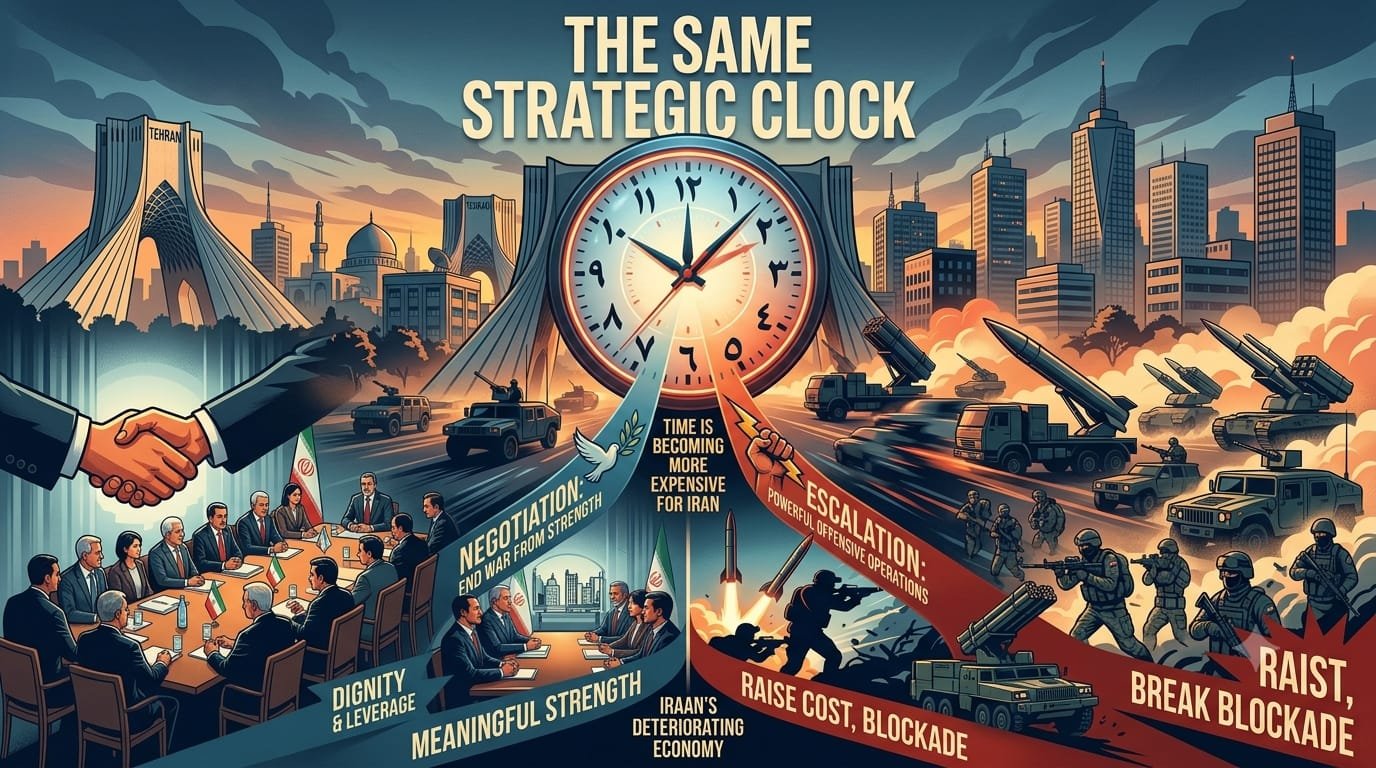
THE SAME STRATEGIC CLOCK
Iran’s deteriorating economic position is producing two very different arguments in Tehran. President Masoud Pezeshkian has argued for finding a way out of the war while Iran can still do so from a position of strength. Other Iranian officials are increasingly discussing offensive operations intended to break the American blockade or increase its cost.
The two positions appear contradictory. They may instead be responses to the same problem: time is becoming more expensive for Iran.
On 19 Aug, Iranian Central Bank Governor Abdolnaser Hemmati offered an unusually stark assessment of the country’s economy. He said Iran’s oil exports had almost stopped because of the U.S. naval blockade and that Iranian industries had access to 30 percent less foreign currency than a year earlier. He described conditions as worse than during the first Trump administration’s maximum-pressure campaign.
Iran has lived under sanctions for decades and has become practiced at finding ways around them. Economic deterioration should not be confused with imminent collapse. But Iran does not have to be approaching collapse for time to matter.
The question is not simply how much economic pain Iran can absorb. It is when Tehran begins to believe that waiting will leave it with fewer options.
In an earlier essay, While Victory Can Still Be Claimed, I examined one possible response. Pezeshkian has argued that the war must eventually end and that Iran should seek to end it while it can still demonstrate strength and dignity. Parliamentary Speaker Mohammad Bagher Ghalibaf has warned that military security cannot be sustained without economic stability.
Neither argument requires believing that Iran has been defeated. Both can begin with the simpler recognition that Iran may have more leverage today than it will have later. Writing recently in Foreign Policy, Said Jafari examined another possible response. He described increasingly explicit calls from Iranian political and military figures for a more offensive posture as the blockade and economic pressure continue.
The language has become difficult to dismiss as isolated rhetoric. When Ahmad Vahidi was appointed commander of the Islamic Revolutionary Guard Corps on 9 Aug, his appointment decree called for readiness to conduct “powerful offensive operations.” A senior Iranian official subsequently told Reuters that Iran could move toward a “fully offensive” posture if diplomacy remained deadlocked and threatened action to break the blockade.
Jafari’s argument is that continued economic pressure could encourage Iran to escalate before its ability to impose costs declines further. These statements do not establish the existence of two organized factions inside Tehran. They reveal two increasingly plausible responses to the same deterioration.
For those advocating negotiation, there is reason to reach an agreement while Iran still possesses meaningful bargaining power. Military capability, regional influence and the ability to impose economic costs all have value at a negotiating table. Waiting risks bargaining later with less.
The case for escalation starts in much the same place, but leads somewhere very different. If Iran expects its position to worsen, there is reason to use some of its remaining capabilities before their value declines. The purpose need not be to win a larger war. It could simply be to raise the economic or military cost of maintaining the blockade enough to change Washington’s calculation.
There is also a third possibility.
Iran may believe it can endure.
Years of sanctions have forced the country to develop alternative trading relationships, informal financial networks and mechanisms for keeping parts of its economy functioning under pressure. Tehran may conclude that Washington is overestimating how quickly economic pressure will translate into strategic vulnerability. If Iranian leaders continue to believe that, the decision can be postponed. If they stop believing it, waiting begins to look different. This is where the logic of sustained economic pressure becomes complicated.
Economic coercion assumes that time will eventually improve Washington’s bargaining position by reducing the choices available to Tehran. But reducing an adversary’s choices does not determine which of the remaining choices it will make.
Compromise may become more attractive. As Iran’s position deteriorates, however, waiting acquires costs of its own.
Escalation carries enormous risks. Washington might respond to greater Iranian pressure not by negotiating, but with additional strikes against capabilities Tehran still considers essential. An attempt to recover leverage could accelerate its loss.
Iranian leaders understand that possibility. What matters is when they begin to believe continued restraint carries the greater risk. That threshold cannot easily be observed from Washington. Tehran may not know precisely where it lies either.
Political and military leaders rarely decide in advance that a particular level of economic deterioration will require action. The calculation develops as circumstances change, options narrow and assumptions about the future become harder to sustain.
This may help explain some of the apparently conflicting signals now coming from Iran. Calls for negotiations can become more urgent even as discussion of offensive operations becomes more serious. They need not represent competing assessments of Iran’s position. They may reflect disagreement over what to do about it.
The argument for negotiation and the argument for escalation are being generated by the same strategic clock.
That creates a problem for prolonged economic pressure. The longer it continues, the more Iran’s economic position may deteriorate. That can strengthen the incentive to negotiate. But it can also bring Tehran closer to the point at which waiting appears more dangerous than acting.
The danger is not simply that Iran may escalate.
It is that the window in which Tehran believes negotiation can preserve something, and the window in which it believes escalation can recover something, may be closing together.
The question is which window Tehran decides is closing taster.