
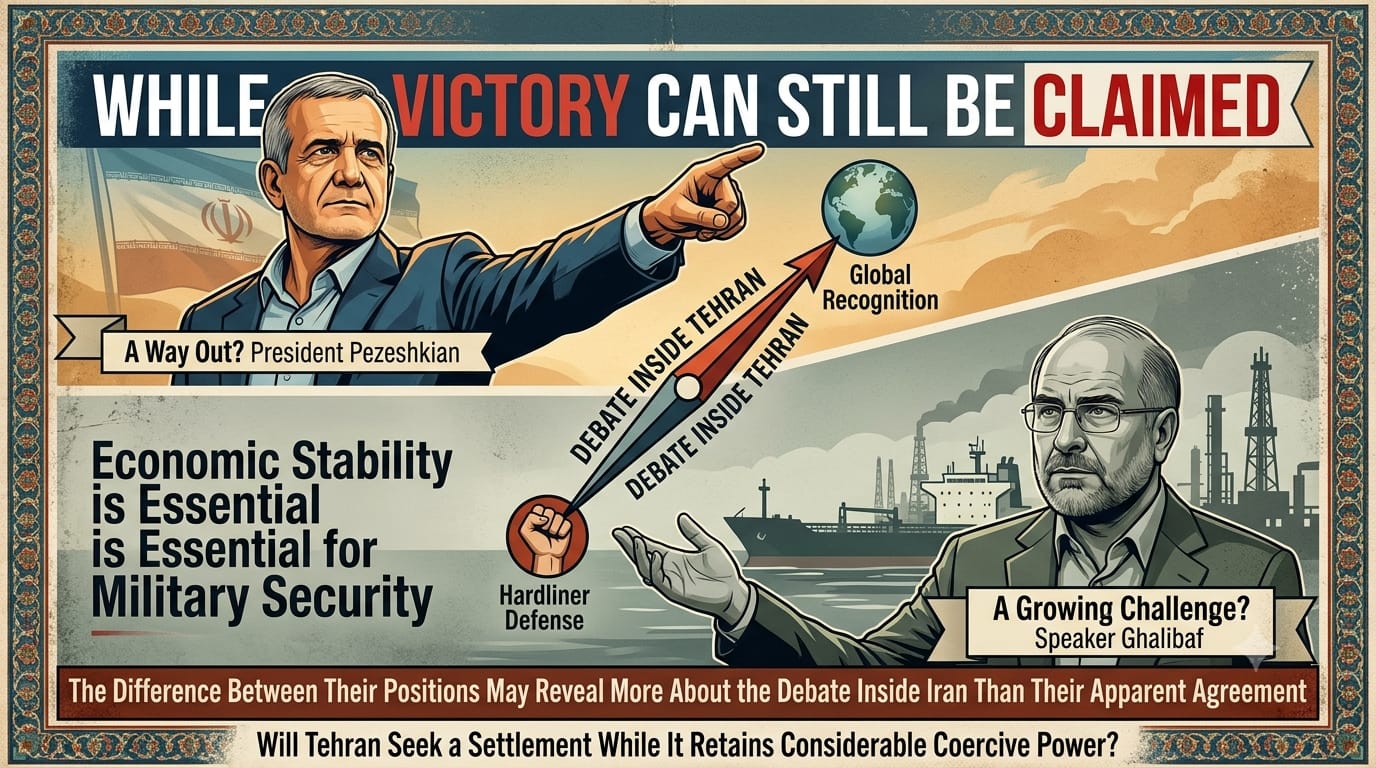
WHILE VICTORY CAN STILL BE CLAIMED
Christopher J. writes about leadership, judgment, responsibility, and institutional trust. Drawing on a career in international affairs and public service, his essays explore how people and institutions make decisions under conditions of uncertainty, constraint, and consequence.
A recent Wall Street Journal article by Andrew Dowell described two of Iran’s most senior political figures as urging the country to find a way out of the war.
Iranian President Masoud Pezeshkian argued that Iran should end the conflict now, while it could still demonstrate strength and dignity and tell the world it had won.
Mohammad Bagher Ghalibaf, Iran’s parliamentary speaker and a central figure within its political establishment, warned that military security could not be sustained without economic stability.
Taken together, their remarks appeared to signal a growing challenge to Iranian hardliners.
But Pezeshkian and Ghalibaf did not say quite the same thing. The difference between them may reveal more about the debate inside Tehran than their apparent agreement.
Pezeshkian appears ready to bring the war to a close while Iran can still claim that it resisted successfully. Ghalibaf acknowledged the economic danger without saying that the moment for settlement had arrived.
The distinction may be partly calibrated, allowing Tehran to signal both endurance and openness without committing itself fully to either course.
Six months into the conflict, Iran retains considerable coercive power. It can threaten shipping, restrict movement through the Strait of Hormuz and impose costs well beyond the immediate battlefield.
Its recent decision to facilitate the passage of selected Iraqi oil tankers illustrates how Tehran is attempting to apply that influence selectively. Iran does not need to stop all maritime traffic to affect the choices of neighboring governments. The ability to facilitate passage can itself carry political value.
Commercial traffic through the strait remains far below prewar levels. Even limited disruption affects oil markets, shipping decisions and the calculations of governments far removed from Tehran.
Iran can continue the war. What is less certain is whether continuing will improve its position.
The naval blockade, expanding sanctions and interruptions to trade are placing sustained pressure on an economy that was already struggling before the conflict began. Businesses and households are absorbing costs that cannot be sustained indefinitely.
That pressure has not produced the concessions Washington wants. It may, however, be changing the argument within Iran about what the country is defending and what will be required to preserve it.
Ghalibaf’s role makes his intervention significant. He is not an obvious member of Iran’s moderate camp. He is a conservative establishment figure and a former senior commander in the Islamic Revolutionary Guard Corps. He continues to describe American sanctions and the blockade as forms of economic warfare imposed after Washington and Israel failed to defeat Iran militarily.
His warning about the economy belongs within that language of resistance. In Ghalibaf’s formulation, the economic conditions that allow the state to function are part of the security the state is attempting to defend.
He may be arguing for economic preparation for a longer confrontation rather than settlement.
Even so, the public timing of his warning matters. Once economic endurance is defined as a condition of national security, continuing a war that steadily weakens it becomes more difficult to defend.
Pezeshkian is making a more direct case. Iran resisted, survived and prevented its enemies from achieving everything they sought. It can therefore end the war without describing the outcome as surrender.
He is assembling a narrative through which an agreement could be called victory. Ghalibaf may be providing an argument through which economic survival could eventually take precedence over continuing the conflict.
Hardliners continue to demand substantial concessions before Iran fully reopens the Strait of Hormuz. They may believe that time is also placing pressure on the United States and its partners. Disrupted energy markets and a continuing American military commitment give Washington reasons to seek an end.
From Tehran, waiting may still appear rational.
The question is whether Iran’s leverage has reached its most useful point. It can continue imposing costs through Hormuz, but that leverage may not be greater a month from now than it is today.
Continued disruption may increase international pressure on Washington. Yet every additional month gives other states more reason to develop alternative routes, protective arrangements and ways of operating around Iranian threats. Those adaptations could gradually reduce the influence Tehran is able to extract from the same actions.
Economic damage inside Iran follows a different timetable. Lost trade, weakened businesses and declining household purchasing power accumulate even when the military front remains relatively stable. Iran may retain the means to continue the conflict while gradually losing the economic room in which to determine how it ends.
Pezeshkian’s language reveals what any settlement would require inside Iran. It could not easily be presented as a response to sanctions or the blockade. That would validate Washington’s strategy and expose the government to accusations that it had surrendered under pressure.
The war would instead have to end because Iran had already demonstrated what needed to be demonstrated.
Whether that account would persuade Iran’s security establishment is uncertain. But governments often begin defining the meaning of an outcome before deciding whether to accept it. The language creates room for choices that political institutions are not yet prepared to acknowledge.
The remarks by Pezeshkian and Ghalibaf may also begin establishing where responsibility will settle if an opportunity for agreement passes and economic conditions worsen.
Pezeshkian has publicly argued that Iran can still end the conflict from a position of strength. Ghalibaf has publicly recognized that economic deterioration will eventually weaken the security the war is intended to protect.
What neither has established is how much time remains between those two judgments.
Washington will help determine whether they converge. Economic pressure could strengthen the case for an agreement. But if maximalist demands are accompanied by renewed calls for the regime’s collapse, Iranian leaders may conclude that compromise offers the state no protection.
If Tehran cannot identify an achievable way to relieve the pressure, even officials who understand the cost of continuing may conclude that resistance remains the safer choice.
The decisive question is no longer simply whether Iran can continue the conflict. It is whether waiting will improve the terms available to Tehran or consume the position from which it still hopes to negotiate.
Pezeshkian appears to believe that point is approaching.
Ghalibaf has not yet said whether he agrees.