
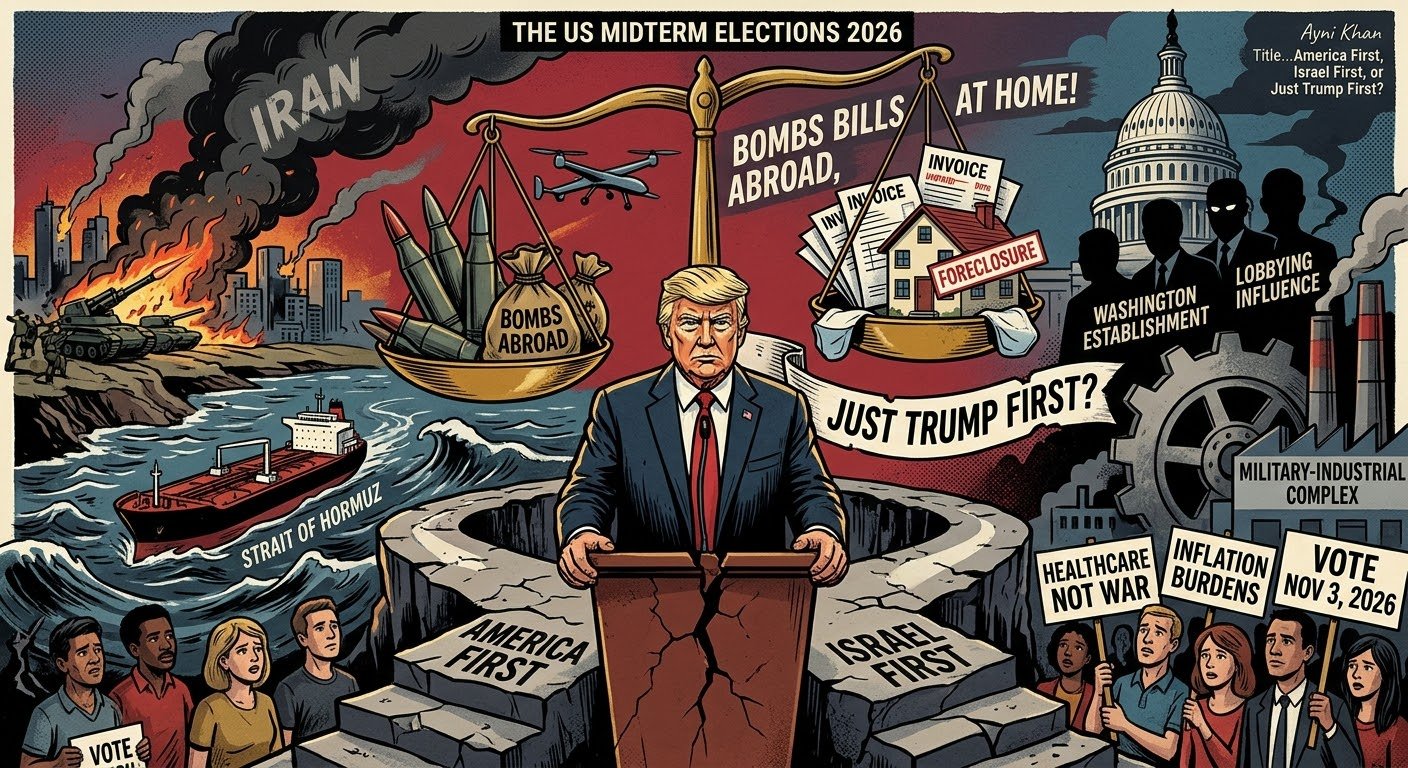
With only two days remaining before the United States midterm elections, scheduled for November 3, 2026, the political stakes in Washington have reached a critical point.
These elections are not merely a contest for control of the US House of Representatives and Senate; they also represent a significant political test of President Donald Trump’s second administration, his economic policies, the war with Iran, America’s relationship with Israel, and the growing tensions between the White House and traditional centres of American power.
The outcome could shape not only the political direction of Washington but also America’s role in global affairs, the future of the Middle East, international economic stability, and the broader balance of global power.
The importance of the US midterm elections lies in the fact that they do not determine the presidency but rather the balance of power in Congress. All 435 seats in the House of Representatives and 35 seats in the Senate are being contested. Republicans currently hold majorities in both chambers, while Democrats are seeking to reverse that position.
If Democrats gain control of the House, the Trump administration could face greater congressional scrutiny, investigations into executive decisions, budgetary pressure, and increased oversight of government policies. If Democrats also gain control of the Senate, their influence over judicial appointments and senior government nominations would increase significantly.
For Trump, these elections are about far more than maintaining his party’s congressional majority. They represent a broader public assessment of his presidential performance.
American voters are increasingly concerned about whether Trump has delivered on his promises to make everyday life more affordable, strengthen domestic industry, and restore America’s economic position, or whether inflation, rising energy costs, trade tensions, and overseas military commitments have undermined his economic agenda.
According to a Reuters/Ipsos poll completed on October 26, 2026, Trump’s approval rating stood at 32 percent. In the same survey, Democrats held a 47-to-36 percent advantage over Republicans among registered voters in the generic congressional ballot. Among likely voters, the figures stood at 53 percent for Democrats and 44 percent for Republicans.
These figures represent public opinion at a particular moment and should not be mistaken for actual election results.
The economy has traditionally been one of the most decisive factors in American elections. During his political campaigns, Trump promised to reduce inflation, strengthen American manufacturing, create employment opportunities, and make the United States economically stronger and more self-reliant.
However, during his second term, the cost of housing, food, healthcare, energy, and other essential goods has remained a major concern for ordinary Americans.
It is important to recognise that inflation and declining purchasing power were already challenges before the war with Iran. The conflict has added another layer of economic pressure, particularly through energy markets and international trade.
Following the joint US-Israeli military operation against Iran in February 2026, tensions in the Middle East intensified and began affecting the global economy.
The Strait of Hormuz became particularly significant because a substantial proportion of the world’s oil and liquefied natural gas shipments pass through this strategic waterway. Any disruption or military escalation in the region can affect global energy prices, maritime insurance, shipping costs, and international supply chains.
Consequently, rising energy prices can place additional pressure on petrol prices, transportation costs, and essential consumer goods in the United States.
This raises an important question: if Trump built his political movement around the principle of “America First”, why has the United States become deeply involved in another prolonged military confrontation abroad?
An Associated Press report in October 2026 described the Iran conflict as an approximately eight-month-long war that had created political difficulties for Republican candidates. The report highlighted concerns about business costs, fuel prices, and the duration of the military engagement.
Some Republican circles continue to describe the war as necessary for national security, while others have raised concerns about its financial costs and its apparent contradiction with Trump’s earlier promises to avoid costly foreign entanglements.
The conflict is not simply a question of military success or failure. It also raises serious questions about public finances.
Overseas military operations, weapons procurement, logistical support, the protection of regional allies, and long-term military commitments can impose substantial financial burdens on the American government.
At the same time, ordinary Americans are questioning why billions of dollars are being committed to overseas military operations when domestic challenges involving healthcare, education, housing, and public infrastructure remain unresolved.
This debate has placed the practical meaning of Trump’s America First policy under increasing scrutiny.
According to a Gallup survey published on October 29, 2026, 50 percent of American voters considered the economy and healthcare extremely important when deciding how to vote, while 47 percent assigned the same level of importance to the situation involving Iran.
Fuel prices were considered extremely important by 42 percent of voters.
These figures demonstrate that the war with Iran is no longer viewed exclusively as a foreign-policy issue; it has become closely connected to the economic security and everyday concerns of American households.
Another major dimension of the American political debate concerns Israel and the influence of pro-Israel lobbying organisations in Washington.
This subject requires careful examination through political funding, electoral activities, congressional voting records, and foreign-policy decisions rather than emotional arguments or sweeping accusations.
The United States has several organisations, political donors, business interests, and religious groups that advocate strong relations with Israel. Among the most prominent is the American Israel Public Affairs Committee, commonly known as AIPAC, which works to strengthen political and diplomatic relations between Washington and Tel Aviv.
An important distinction must be made here: pro-Israel lobbying organisations and the entire Jewish community are not the same thing.
Jewish Americans hold diverse political views. Some strongly support the policies of the Israeli government, others criticise them, while many disagree with particular aspects of American policy towards Israel.
AIPAC and related political activities deserve examination in terms of campaign contributions, Super PAC spending, candidate endorsements, and political advertising against candidates who oppose its policy priorities.
Such activities provide examples of how organised lobbying can influence American electoral politics.
However, the existence of political influence does not, by itself, establish that the US government makes decisions under the direct instructions of a particular lobbying organisation.
The relationship between Donald Trump and Israeli Prime Minister Benjamin Netanyahu is equally significant in this context.
The Trump administration has treated close defence and diplomatic cooperation with Israel as an important component of its Middle East policy. The joint military action against Iran has further highlighted the strategic relationship between the two governments.
This raises an important question: Has Washington given Israeli national and strategic interests a central position in its Middle East policy, and what consequences has this had for American national interests, regional stability, and the economic priorities of ordinary Americans?
Answering this question requires an examination of American military assistance, diplomatic records, defence agreements, regional security arrangements, and the strategic priorities of both countries.
American support for Israel, however, is not limited to one president or one political party. Both Democratic and Republican administrations have maintained extensive defence and diplomatic cooperation with Israel, although disagreements exist within both parties regarding the limits of that support, the Palestinian issue, and America’s broader role in the Middle East.
Therefore, reducing the entire debate to the argument that Trump alone is influenced by Israel would ignore the historical complexity of American foreign policy.
The role of the American establishment is another essential aspect of this political contest.
The term “establishment” in Washington does not necessarily refer to a single secret organisation. Rather, it describes a network of influential political, military, financial, governmental, and institutional interests.
These include the Pentagon, the State Department, intelligence agencies, Congress, defence contractors, major financial institutions, and influential political networks.
These institutions and groups do not necessarily share identical interests, nor do they agree on every major policy decision.
The American president possesses considerable authority over foreign policy and national security. However, presidential power is not unlimited.
Congress exercises influence through legislation and budgetary control, the courts can review executive decisions, and the military and intelligence agencies operate under lawful civilian oversight.
This institutional structure explains why several Trump administration policies have encountered legal challenges, congressional opposition, and institutional disagreements.
The American defence-industrial structure also deserves particular attention.
Major defence contractors, weapons production, military procurement, and overseas American military commitments are connected to a substantial economic and political system.
This relationship is commonly described as the Military-Industrial Complex.
Former US President Dwight D. Eisenhower warned about the potential political influence of this powerful relationship in his farewell address in 1961.
More than six decades later, the debate continues over the extent to which defence contractors and associated economic interests influence American foreign policy.
Nevertheless, it would be inaccurate to suggest that defence companies alone determine America’s military decisions. National security considerations, regional strategy, political leadership, and the interests of international allies also play significant roles.
Trump’s relationship with the traditional American establishment must therefore be examined within this broader institutional context.
Throughout his political career, Trump has criticised Washington’s traditional political class, sections of the federal bureaucracy, and certain international alliances. He has argued that American foreign policy should place US national interests above other considerations.
Yet his administration has also maintained traditional defence partnerships, continued close relations with Israel, and preserved America’s strategic involvement in global power politics.
This apparent contradiction between the rhetoric of America First and the realities of American foreign policy has become an important subject of political debate.
Relations with China and Russia provide another important dimension to the upcoming elections.
Competition with China over trade, advanced technology, Taiwan, and global supply chains remains one of the central challenges facing American foreign policy.
Relations with Russia continue to be shaped by the war in Ukraine, European security, and the future of NATO.
The conflict with Iran has further concentrated American military and diplomatic resources in the Middle East, potentially affecting Washington’s ability to pursue its wider strategic priorities.
The outcome of the midterm elections will also have implications beyond the political future of Donald Trump.
If Democrats gain control of the House of Representatives, the administration could face more extensive congressional investigations, greater scrutiny of defence spending, and increased pressure over foreign-policy decisions.
If Republicans retain their majorities, Trump may have greater political room to pursue legislation and secure government appointments.
The Democratic Party, however, also faces its own political challenges. It cannot rely exclusively on opposition to Trump. It must present credible alternatives on the economy, healthcare, immigration, employment, and foreign policy.
A section of the American electorate may oppose Trump’s policies without necessarily agreeing with every position adopted by the Democrats.
From an international-relations perspective, these elections are also significant for Pakistan and other countries in the region.
Washington’s policy towards Iran, security in the Persian Gulf, relations with Israel, the future of Afghanistan, and strategic competition with China can all have direct or indirect consequences for South Asia.
For Pakistan, relations with neighbouring Iran, regional trade, energy requirements, and instability in the Middle East are particularly important considerations.
A change in congressional control could affect the scrutiny of American foreign policy and the allocation of government resources. However, it would not necessarily produce an immediate or complete transformation of US foreign policy.
Ultimately, the November 3, 2026, elections represent an important moment for American democracy.
They will provide an opportunity for voters to express their judgment on the Trump administration’s economic performance, military commitments, and foreign-policy priorities.
The war with Iran, inflation, relations with Israel, defence spending, and tensions between American institutions have made this electoral contest particularly significant.
The real question, however, is not simply whether Democrats will win or Republicans will retain their congressional majorities.
The deeper question is whether American political institutions will give greater priority to the economic concerns of ordinary citizens and the country’s long-term national interests when making foreign-policy decisions.
Will Washington reconsider the use of its military power? Will the relationship with Israel, the confrontation with Iran, and rising defence expenditure face greater scrutiny in Congress? And will Trump be able to reconcile the promises that brought him to power with the realities of his administration’s decisions?
The United States remains one of the world’s leading economic and military powers. Political developments in Washington therefore rarely remain confined within American borders. Their consequences extend to international financial markets, global energy prices, Middle Eastern stability, relations with China and Russia, and the broader balance of international power.
For this reason, the 2026 midterm elections are not merely a contest between two American political parties. They are also an important test of America’s future role in an increasingly uncertain and changing international order.
Research References and Further Reading
Reuters — US 2026 Midterm Elections: Political Overview.
Reuters/Ipsos — Trump’s Approval Rating and Congressional Polling, October 26, 2026.
Gallup — Key Issues Influencing American Voters, October 29, 2026.
Associated Press — The Iran War and Its Political Impact on US Elections.
Council on Foreign Relations — Iran, Trade Policy, and American Elections.
European Parliament Research Service — Analysis of the 2026 US Midterm Elections.
Reuters — Potential Consequences of the Midterms for Trump’s Presidency.
Editorial note: This analysis is framed around information available as of November 1, 2026. Opinion polls should not be treated as final election results.