
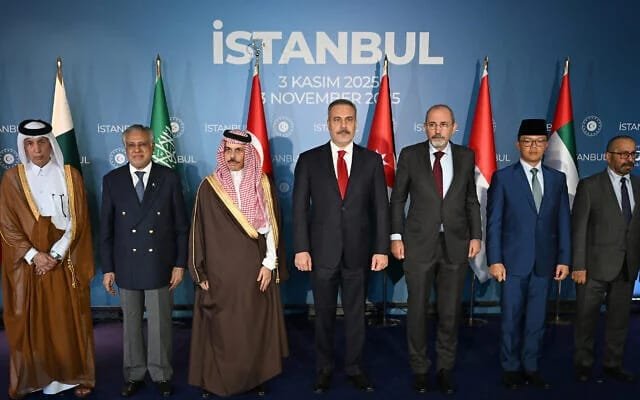
The October Istanbul Summit marks a structural break with post-Cold War unilateralism. By formalizing the R4+E4 bloc an equal weight alliance coupling Europe’s core economic heavyweights with a newly minted Middle Eastern South Asian powerhouse the summit has fundamentally altered the global diplomatic playbook. For the first time Europe’s central powers and key regional anchors have institutionalized a unified mechanism to co-manage regional and trade security.
The Coalition comprises the R4 (Egypt, Pakistan, Saudi Arabia, and Türkiye) and the E4 (Germany, France, Italy, and the United Kingdom). Co anchored by Turkish Foreign Minister Hakan Fidan and German Foreign Minister Johann Wadephul, the summit delivered a rigorous structural audit of all eight chief diplomats, moving bilateral friction points into a multilateral framework. In a direct challenge to traditional Western security calculus, the eight powers delivered a blunt, collective warning to the United States and Israel against further military strikes on Iran. Explicitly cautioning that renewed escalation would create nothing but losers, the bloc has signaled zero tolerance for destabilizing ripple effects across an already fragile region. With concurrent conflicts including the war in Ukraine threatening international supply chains, the summit’s defining mandate prioritizes immediate back-channel diplomacy to halt choke point disruptions and prevent a total collapse of global commerce.
The coalition leverages distinct regional capacities, exemplified by the UK’s focus on securing the Strait of Hormuz, Egypt’s defensive security commitments to Saudi Arabia, and a unified, UN aligned push for a two-state solution. The core agenda aggressively safeguards vital energy networks and international grain exports. The alliance’s sudden emergence is not a diplomatic accident; it is the culmination of a rapid, calculated consolidation. The trajectory traces from Pakistan’s early 2026 Washington Tehran shuttle diplomacy, through the watershed Islamabad ‘MoU’ on June 18, and the ‘Makkah Joint Defense Pact’ in August, culminating in the integration of the Eurotroika and Italy in Istanbul. Having successfully executed its foundational audit and secured consensus in Turkey, the coalition has accepted an invitation from German Foreign Minister Johann Wadephul to convene its next session in Germany.
As the R4+E4 institutionalizes its leverage, Washington, Brussels, and regional capitals alike must adapt to a multipolar reality where Europe and its Southern partners co-author the rules of global security. The Summit marks a watershed moment of transactional geopolitics, where the Regional Four (R4) successfully weaponized their choke points to extract binding structural concessions from Europe. Rather than engaging in traditional diplomatic deference, the bloc leveraged acute European vulnerabilities ranging from maritime insecurity and supply chain bottlenecks to sovereign debt and diplomatic mediation needs to force hard economic and technological payouts.
Saudi Arabia leveraged Red Sea security to secure binding European state underwriting for sovereign co investments into NEOM and Oxagon, alongside 20 year fixed price import contracts for green hydrogen. Türkiye exploited Europe’s urgency to bypass volatile shipping lanes, demanding an immediate expansion of the EU Customs Union to services and agriculture, backed by massive EIB financing for Caspian rail corridors. Egypt capitalized on Suez Canal revenue bleed from shipping diversions to force large scale, Euro denominated debt for infrastructure and climate swaps with Berlin and Rome. Pakistan utilized unmatched regional mediation back channels and hard security leverage to dismantle Western dual use tech export bans, securing co production deals for advanced maritime radar and deep sea surveillance hardware.
As international media scrambles to decode the long term fallout of the R4+E4 summit, national discourse across the eight allied capitals reveals a sharply converging set of strategic priorities. Far from a uniform echo chamber, each power is leveraging the Istanbul consensus to secure distinct domestic and geopolitical gains. Pakistan State media and ‘Dawn’ frame the summit as a monumental triumph for Deputy PM and Foreign Minister Ishaq Dar. The consensus validates 18 months of high stakes, behind the scenes Washington Tehran shuttle diplomacy, vaulting Islamabad into an unprecedented position of global diplomatic prominence. Turkish Anadolu Agency champions Foreign Minister Hakan Fidan’s proactive doctrine as a masterclass in regional responsibility, Ankara is effectively weaponizing Western dependence on local arbiters to constrain Israeli military expansion and lock down critical maritime corridors.
Egyptian ‘Al Ahram’ foregrounds Foreign Minister Badr Abdelatty’s laser focus on economic preservation, balancing threatened Suez Canal and tourism revenues. Simultaneously, Cairo’s National Defence Council is weighing direct defensive shield operations to safeguard Saudi infrastructure from Houthi attacks. Saudi Arabia is adopting a hardline posture against ongoing Houthi strikes on critical assets. The kingdom’s core message is clear: freedom of navigation across the Red Sea and the Bab al-Mandab cannot be decoupled from a comprehensive, permanent Middle Eastern peace settlement. Germany in a strategic pivot highlighted by ‘Deutsche Welle’, Foreign Minister Johann Wadephul signaled Berlin’s willingness to bypass U.S. hardliners. Driven by the urgent threat of a global grain and fertilizer famine, Germany and the Eurotroika are pushing to restart direct security and nuclear talks with Tehran.
British coverage centers on Foreign Secretary Ed Miliband’s aggressive push to secure the Strait of Hormuz backed by RAF Typhoon deployments over Saudi airspace, London views the E4 architecture as a vital, operational vehicle to project British influence and safeguard vital trade routes post Brexit. As digital discourse across think tanks, journalists, and official channels races to decode the summit, online analysis has crystallized around three profound structural shifts.
Across X (Twitter), observers note that the R4+E4 architecture is rapidly rewriting traditional alliance rules. Islamabad’s Hard security pivot, A viral readout from Pakistan’s Foreign Office (@ForeignOfficePk) detailing the R4 delegation’s meeting with Turkish President Recep Tayyip Erdoğan explicitly spotlighting Chief of Defence Forces Field Marshal Syed Asim Munir marked a watershed moment. Analysts observe that this high level military integration signals the alliance’s rapid evolution from a conventional diplomatic talk shop into an institutionalized, hard security bloc capable of projecting joint deterrence.
Amplifying reports from ‘Reuters’ and ‘Al Jazeera’, regional analysts argue that the unified E4–R4 front forms a formidable geopolitical roadblock against U.S. hawkishness. By establishing a collective consensus, the eight powers are signaling to Washington and Tel Aviv that any fresh Western military escalation in the Gulf will encounter coordinated diplomatic and strategic pushback. Foreign policy commentators are dissecting Berlin’s strategic pivot, dubbing it the emerging ‘Wadephul Doctrine’.
Upgrading the traditional E3 framework to an E4 configuration by integrating Italy represents a calculated European bid to forge an autonomous foreign policy. Driven by acute vulnerabilities, this axis aims to manage energy crises and secure continental stability independently of traditional U.S. hegemony. Geopolitics met raw survival economics as analysts branded the bloc an emergency inter continental committee designed to prevent Red Sea and Black Sea blockades from triggering global food and energy riots. Diplomatic momentum shifts to Berlin, where the coalition will convene its next ministerial session to institutionalize its newfound geopolitical weight.