
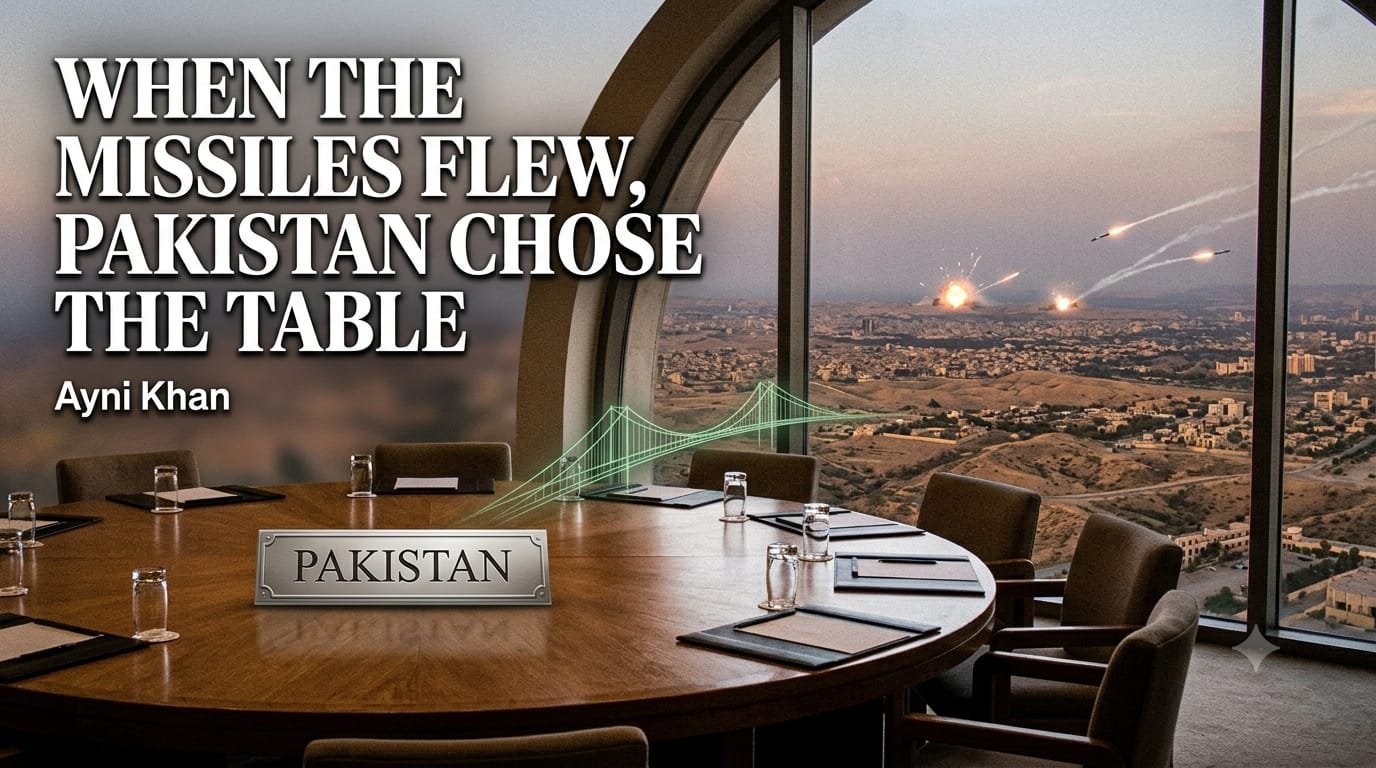
Wars are usually measured in missiles, military victories, territory gained and enemies defeated.
But the recent conflict involving Iran has raised a different question:
Can a country gain something from a war without actually fighting it?
For Pakistan, the answer may be yes.
Pakistan did not enter the conflict as a military participant. Instead, Islamabad chose diplomacy, communication and mediation. At a time when tensions between Iran and the United States were threatening to destabilize an already fragile region, Pakistan attempted to position itself as a bridge between opposing sides.
That may not be a conventional victory.
But in international politics, not every victory is measured on the battlefield.
Sometimes, the most valuable achievement is getting rivals to sit at the same table.
A Difficult Geography, and an Unexpected Opportunity
Pakistan’s geography has always been both an advantage and a challenge.
It shares a border with Iran, maintains close relations with the Gulf states, and has a long history of diplomatic and strategic engagement with the United States.
When tensions escalated between Iran and the United States, Pakistan found itself in an unusually sensitive position.
Choosing one side completely could have carried serious consequences.
Instead, Islamabad attempted to keep channels open with multiple sides and present itself as a country capable of facilitating dialogue.
The diplomatic efforts that brought international attention to Islamabad demonstrated something important: Pakistan does not necessarily have to choose between being a regional stakeholder and a peace broker.
It can potentially be both.
So, What Did Pakistan Actually Win?
Pakistan did not win a military victory.
It did not capture territory.
It did not defeat another army.
What it potentially gained was something less visible but strategically important:
Diplomatic relevance.
For years, Pakistan’s image in international media has often been dominated by political instability, security challenges, economic difficulties and tensions in South Asia.
Its role during the Iran crisis offered a different narrative.
For once, Pakistan was being discussed not simply as a country affected by regional instability, but as a country that could potentially help manage it.
That is a significant shift.
But diplomatic relevance is only valuable if Pakistan can sustain it beyond a single crisis.
The Other Pakistan: The People at Home
There is, however, another side to this story.
While Pakistan’s diplomats engage with regional and international powers, ordinary Pakistanis are dealing with a very different reality.
For millions of citizens, international diplomacy matters only when it eventually improves everyday life.
Families are struggling with rising living costs, expensive electricity and gas bills, limited employment opportunities, increasing education and healthcare expenses, and growing uncertainty about the future.
For the average Pakistani, the question is not simply whether Islamabad successfully mediated between Iran and the United States.
The more immediate question is:
Will any diplomatic success make life easier for ordinary people?
This is where foreign policy meets the kitchen table.
If oil prices rise because of a regional war, transportation becomes more expensive. When transportation costs increase, food and other essential goods become more expensive. Energy insecurity eventually finds its way into household budgets.
For a country already facing economic pressure, a prolonged regional conflict could therefore become another burden on the public.
Pakistan’s pursuit of peace is consequently not just a matter of diplomacy.
It is also a matter of economic survival.
The Pakistani Public Does Not Want Another War
There is a powerful sentiment that should not be ignored: ordinary Pakistanis do not want their country dragged into another regional conflict.
They want peace.
They want jobs.
They want affordable electricity.
They want better education and healthcare.
And above all, they want some confidence that tomorrow will be better than today.
Pakistan can play an important diplomatic role in the region, but its citizens will ultimately judge that role through the realities of their own lives.
A diplomatic achievement that makes headlines abroad but produces no relief at home will eventually feel distant to the people who matter most.
The challenge for Islamabad, therefore, is not simply to build international influence.
It is to convert that influence into stability and opportunity for its own population.
Can Pakistan Really Become a Mediator?
Being a mediator is far more difficult than making a diplomatic statement.
A credible mediator must maintain the trust of competing parties without becoming the spokesperson for any one of them.
Pakistan faces a particularly delicate balancing act.
Iran is its neighbour.
The Gulf states are important partners.
The United States remains a major global power with which Pakistan has longstanding relations.
At the same time, Pakistan itself is dealing with economic and domestic pressures.
This means Islamabad cannot afford reckless foreign-policy choices.
Its strongest position may be to remain a participant in peace rather than a participant in war.
That distinction could define Pakistan’s regional role in the years ahead.
The Real Test Begins After the Headlines
Diplomacy often receives attention during a crisis and disappears once the cameras leave.
That cannot be Pakistan’s approach if it wants to build a lasting role.
If Islamabad genuinely wants to emerge as a credible regional mediator, it will need to strengthen its diplomatic institutions, maintain balanced relationships and develop a foreign policy that is consistent rather than crisis-driven.
Pakistan has geography.
It has relationships across the region.
It has historical connections with major Muslim countries.
It also has the potential to use its diplomatic position to encourage dialogue on issues far beyond the Iran crisis.
But potential is not enough.
Credibility has to be earned.
What Happens Next?
The Iran conflict may eventually be remembered not only for its military consequences, but also for the diplomatic realignments it produced across the region.
For Pakistan, this could become a turning point.
It could remain a country constantly reacting to crises around it.
Or it could become a country that actively helps prevent those crises from becoming larger wars.
The difference will depend on whether Islamabad can turn a moment of diplomatic visibility into a long-term strategy.
And there is another measure of success that should never be forgotten.
Pakistan’s foreign policy must ultimately serve Pakistan’s people.
Because the real strength of a country is not measured only by the influence its diplomats have in foreign capitals.
It is measured by whether ordinary citizens feel secure in their own homes.
A Seat at the Table
So, what did Pakistan gain from the Iran war?
Not territory.
Not military glory.
Not a conventional victory.
What Pakistan may have gained is something potentially more valuable:
A seat at the diplomatic table.
The world has seen that Pakistan can potentially serve as a bridge when regional powers are divided.
Now comes the harder part.
Pakistan must prove that it can maintain that role while protecting its own national interests—and, equally importantly, while addressing the economic hardships facing its people.
Because ultimately, foreign policy is not successful simply because it makes headlines.
It is successful when the people back home can feel its benefits.
Pakistan may have earned a seat at the table.
Now it must make sure that the voice coming from that table is heard by the ordinary Pakistani at home. b