
Christopher J. writes about leadership, judgment, responsibility, and institutional trust. Drawing on a career in international affairs and public service, his essays explore how people and institutions make decisions under conditions of uncertainty, constraint, and consequence.
WHY ALLIANCES ENDURE
Over the course of my career, I worked alongside diplomats, military officers, and intelligence professionals from many NATO countries. Embassy assignments ended. People rotated to new capitals. Crises emerged in different parts of the world. The relationships remained. An officer from one allied embassy might later become a senior commander. A diplomat assigned to one country might appear years later in another. An intelligence counterpart from one assignment may become the person you call during the next crisis.
The geography changed.
The relationships endured.
An alliance cannot wait until a crisis begins to discover whether its members trust one another. By then, it is too late. That is one of the least understood strengths of an alliance. Most discussions about NATO begin with military capability.
How much should allies spend?
How many brigades are available?
Who contributes the most?
Those are legitimate questions. I have long believed European allies should continue investing more in their own defense. An alliance is stronger when every member contributes meaningfully to the common defense.
But those debates often overlook something more fundamental. Military power is only one component of an effective alliance. An equally important function is reducing uncertainty.
Alliances do more than combine military strength. They establish shared expectations and familiar patterns of cooperation long before those expectations are tested. When governments spend decades planning, exercising, sharing intelligence, and responding to crises alongside one another, they develop confidence in how each will act. That confidence cannot be measured as easily as defense budgets. Yet it shapes decisions every day. Commanders understand how allied units operate. Diplomats know whom to call when events begin moving quickly. Intelligence services develop confidence in the reliability of shared information. Political leaders inherit relationships and institutional networks that existed long before they entered office.
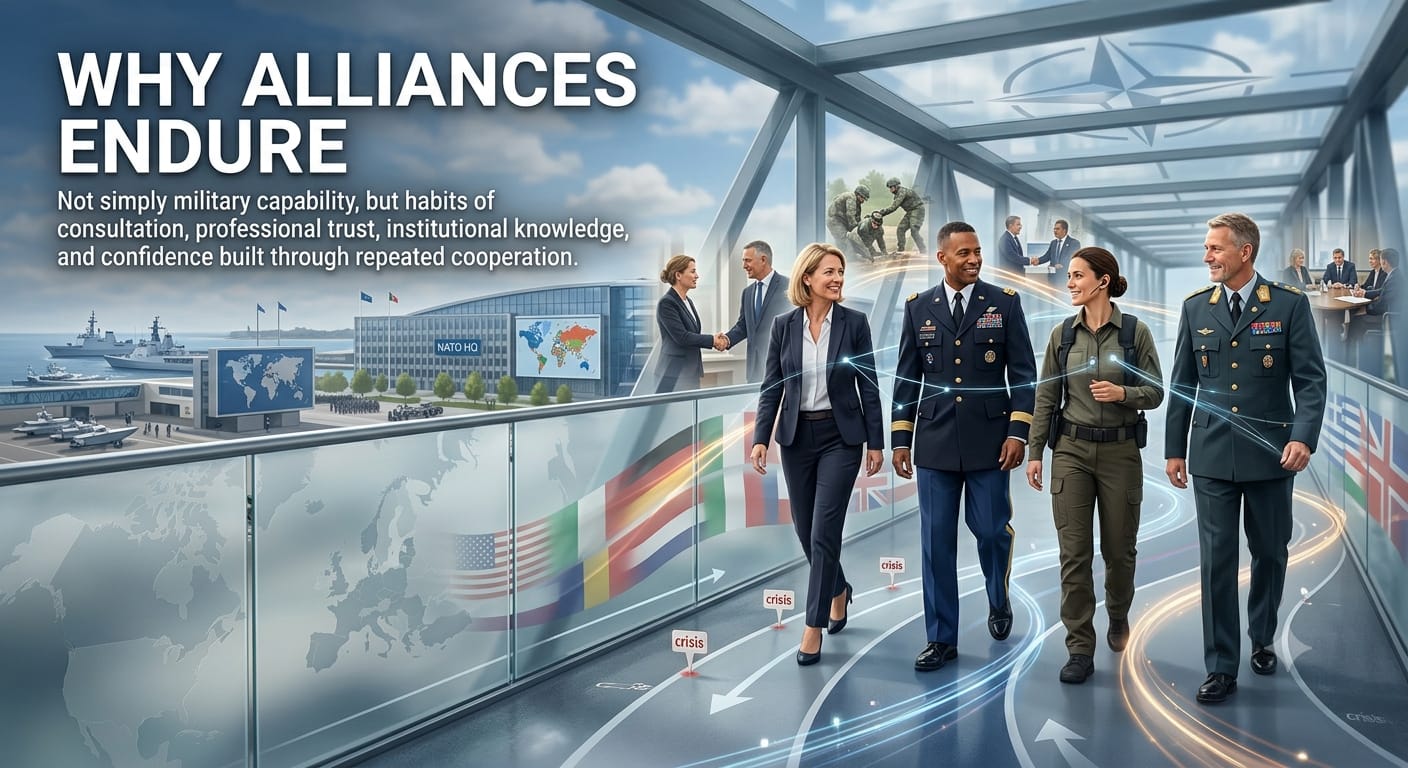
All of this reduces friction precisely when time matters most. This is why alliances are about more than collective defense. They are institutions in which strategic capital accumulates over time. Not simply military capability, but habits of consultation, professional trust, institutional knowledge, and confidence built through repeated cooperation. Like any strategic asset, those relationships should never be immune from reassessment. International politics changes, and governments have an obligation to determine whether longstanding commitments continue to serve their national interests. Reassessment, however, is not the same as starting over.
Many military capabilities can be expanded within a few years. Relationships between institutions cannot be accelerated. Neither can the confidence built through decades of cooperation, or the practical understanding that comes from working together around the world. Perhaps that is NATO’s most enduring contribution.
Not merely that it allows nations to act together when conflict begins. When the first hours of a crisis arrive, governments no longer have time to build trust. They draw upon the trust that decades of cooperation have already created.